
Search
Remove Ads
Advertisement
Search Results
Definition
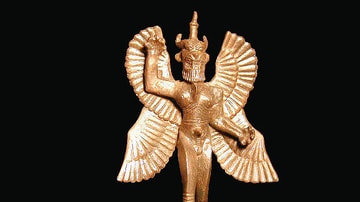
Pazuzu - The Mesopotamian Demon of Destruction and Protection
Pazuzu is a Babylonian/Assyrian demon who was most popular in the first millennium BCE. He was the son of Hanbi (also Hanba), king of the demons of the underworld, and brother of Humbaba, the...
Article
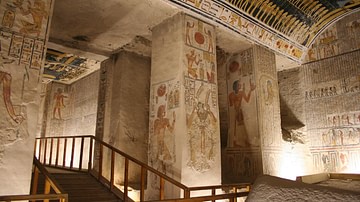
Tomb Robbing in Ancient Egypt
The tombs of the great kings and nobles of Egypt were built to safeguard the corpse and possessions of the deceased for eternity and yet, while many have endured for thousands of years, their contents often disappeared...

Quiz
Egyptian Pyramids, Hieroglyphics, & Art
Egyptian Pyramids, The Sphinx, Egyptian Art, Egyptian Symbols, Egyptian Architecture, Egyptian Hieroglyphics, The Rosetta Stone

Article
Police in Ancient Egypt
In any society, members of the community recognize they are required to restrain certain impulses in order to participate in the community. Every civilization has had some form of law which makes clear that the benefits...
Article
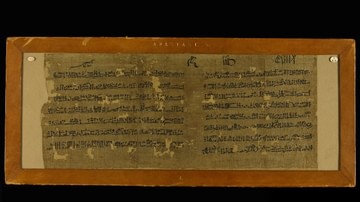
Prayer to Thoth for Skill in Writing
The Prayer to Thoth for Skill in Writing is a literary piece dated to c. 1150 BCE from the latter period of the New Kingdom of Egypt (c. 1570- c. 1069 BCE) in which a young scribe prays for inspiration to Thoth...

Article
Ten Ancient Persia Facts You Need to Know
Ancient Persian culture exerted a powerful influence throughout the Near East, and beyond, for over a thousand years between c. 550 BCE - 651 CE and many aspects of their culture continued to influence others...

Article
A Brief History of the Dog Collar
The dog collar, so often taken for granted, has a long and illustrious history. Anyone fortunate enough to share their life with a dog in the present day is participating in an ancient tradition every time they place...

Article
Ghosts in the Middle Ages
The medieval Church informed the people's religious imagination during the Middle Ages (c. 476-1500) and the world was therefore interpreted - even by heterodox Christians - through the Church's lens. Ghosts – referred...

Article
Roman Household Spirits: Manes, Panes and Lares
To the ancient Romans, everything was imbued with a divine spirit (numen, plural: numina) which gave it life. Even supposedly inanimate objects like rocks and trees possessed a numen, a belief which no...

Article
Religion in the Mongol Empire
The Mongol Empire (1206-1368 CE) covered Asia from the Black Sea to the Korean peninsula and so naturally included all manner of religions within its borders, but the Mongols themselves had their own particular religious...
