
Search
Remove Ads
Advertisement
Search Results

Definition
Sleipnir
Sleipnir is the eight-legged horse ridden primarily by the god Odin in Norse mythology. He is the son of the god Loki (in the form of a mare) and the stallion Svadilfari who belonged to the jötunn that built the walls of Asgard. In...

Definition
Blaise Pascal
Blaise Pascal (1623-1662) was a French scientist, mathematician, and philosopher whose work influenced both the Scientific Revolution and later European thought. Pascal is known for his practical achievements in science, such as...

Article
The Magical Lullaby of Ancient Egypt
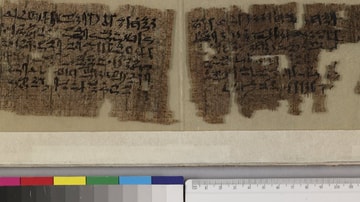
The Magical Lullaby (popularly known as Charm for the Protection of a Child) is an inscription from the 16th or 17th century BCE. The poem exemplifies the ancient Egyptian's personal religious and spiritual practices...
Article
The Tale of Sinuhe
The Middle Kingdom of ancient Egypt (2000 BCE – 1700 BCE) saw the start of more formal writing which included religious scripts, administrative notes, and more in-depth fictional writing. One of the most iconic pieces of writing...

Article
Day of the Dead
The Day of the Dead, known in Spanish as Día de los Muertos, is a holiday that celebrates life and honors the dead through traditions, food, decorations, and activities intended to sustain the connections between the living and...
Article
Tattoos in Ancient Egypt
Tattoos are an ancient form of art appearing in various cultures throughout history. One of the earliest (and possibly the oldest) pattern of tattoos in the world was discovered on the frozen remains of the man known as...

Definition
Cambyses II
Cambyses II (r. 530-522 BCE) was the second king of the Achaemenid Empire. The Greek historian Herodotus portrays Cambyses as a mad king who committed many acts of sacrilege during his stay in Egypt, including the slaying of the sacred...

Definition
Science
The term science comes from the Latin word scientia, meaning "knowledge". It can be defined as a systematic attempt to discover, by means of observation and reasoning, particular facts about the world, and to establish laws connecting...

Definition
Cleopatra Selene II
Cleopatra Selene II (40 - c. 5 BCE) was a member of the Ptolemaic Dynasty who became the queen of Mauretania upon her marriage to King Juba II of Numidia (48 BCE - 23 CE). Though more obscure than her famous mother, Cleopatra...

Definition
Suppiluliuma I
Suppiluliuma I (1344-1322 BCE) is considered the most powerful and impressive king of the Hittite Empire. He was the son of Tudhaliya II (also known as Tudhaliya III) and is credited with founding the New Kingdom of the Hittites...
