
Search
Remove Ads
Advertisement
Search Results

Quiz
Daily Life & Afterlife in Ancient Egypt
Afterlife Book of the Dead Canopy Class Coffin Texts Domestic Cult Field of Reeds Heka Kites of Nephthys Ma'at Nomarch Pyramid Texts Rite Scribe Senet Shabti Dolls Silo Veneration Vizier
Article
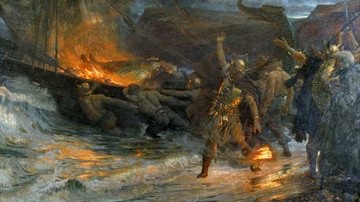
Norse Ghosts & Funerary Rites
In Norse belief, the soul of the deceased might wind up in any one of a number of afterlife realms. There was Valhalla, the realm of Odin where the dead warriors drank, fought, and told stories, Folkvangr ('the Field...

Definition
Apis
Apis was the most important and highly regarded bull deity of ancient Egypt. His original name in Egyptian was Api, Hapi, or Hep; Apis is the Greek name. He is not, however, associated with the god Hapi/Hep who was linked to the inundation...

Definition
Bastet
Bastet is the Egyptian goddess of the home, domesticity, women's secrets, cats, fertility, and childbirth. She protected the home from evil spirits and disease, especially diseases associated with women and children. As with many deities...

Definition
Djed
The djed is an ancient Egyptian symbol for stability which features prominently in Egyptian art and architecture throughout the country's history. `Stability' should be understood to mean not only a firm footing but immutability and permanance...

Video
Ancient Egyptian Dance and Music
In Ancient Egyptian society, both dance and music were highly valued. They were integral to creation and communication with the gods and there was an intrinsic link between music and dance and the divine. The goddess...

Definition
Neith
Neith (aka Net, Neit or Nit) and is one of the oldest deities of ancient Egypt who was worshipped early in the Pre-Dynastic Period (c. 6000 - 3150 BCE) and whose veneration continued through the Ptolemaic Dynasty (323 - 30 BCE), the last...

Article
The Economy of Ptolemaic Egypt
Ptolemaic Egypt rapidly established itself as an economic powerhouse of the ancient world at the end of the 4th century BCE. The wealth of Egypt was owed in large part to the unrivalled fertility of the Nile, which...

Definition
Heka
Heka is the god of magic and medicine in ancient Egypt and is also the personification of magic itself. He is probably the most important god in Egyptian mythology but is often overlooked because his presence was so pervasive as to make...

Image Gallery
A Gallery of Ancient Egyptian Art
Ancient Egyptian art was created to serve a practical purpose, not for its own sake, and so every piece had a specific function. At the same time, these works were crafted in accordance with the cultural value of...
