
Search
Remove Ads
Advertisement
Search Results

Definition
Dagobert I
Dagobert I (l. 605-639) ruled as King of Austrasia from 623 to 634 and as King of All the Franks from 629 to 639. Together with the reign of his father, Chlothar II, the period of Dagobert's rule has been characterized as the peak...

Definition
Emperor Xuanzong of Tang
Xuanzong (birth name, Li Longji, l. 685-762 CE, r. 712-756 CE) was the 7th emperor of the Tang Dynasty of China, whose domestic and foreign policies established the Tang Dynasty as the Golden Age in Chinese history. Many...

Definition
Ancient Egyptian Architecture
Ancient Egyptian architecture is often associated closely with the pyramids of Giza but was actually quite diverse, taking a number of forms in the construction of administrative buildings, temples, tombs, palaces...

Definition
The Great Sphinx of Giza
The Great Sphinx of Giza is the most instantly recognizable statue associated with ancient Egypt and among the most famous in the world. The sculpture, of a recumbent lion with the head of an Egyptian king, was carved out...

Definition
Sun-Tzu
Sun Tzu (l. c. 500 BCE) was a Chinese military strategist and general best known as the author of the work The Art of War, a treatise on military strategy (also known as The Thirteen Chapters). He was associated (formally or as an inspiration...
Definition
Battle of Gaixia
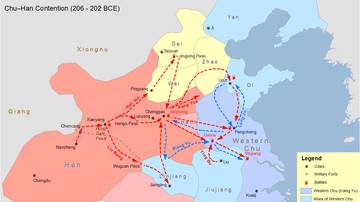
The Battle of Gaixia (202 BCE, also known as Kai-Hsia) was the decisive engagement of the Chu-Han Contention (206-202 BCE) at which Liu Bang (l. c. 256-195 BCE), from the State of Han, defeated Xiang Yu (l. 232-202 BCE) of the...

Definition
Narmer Palette
The Narmer Palette (also known as Narmer's Victory Palette and the Great Hierakonpolis Palette) is an Egyptian ceremonial engraving, a little over two feet (64 cm) tall and shaped like a chevron shield, depicting the First Dynasty...

Definition
Battle of Red Cliffs
The Battle of Red Cliffs (also known as the Battle of Chibi, 208 CE) was the pivotal engagement between the forces of Northern China led by the warlord Cao Cao (l. 155-220 CE) and the allied defenders of the south under the...

Definition
Kublai Khan
Kublai Khan (Qubilai-Qan) was the ruler of the Mongol Empire from 1260 to 1294. His accomplishments include establishing Mongol rule in China under the name of the Yuan Dynasty (1271-1368), thus becoming the first non-Chinese to rule...

Definition
Holy Roman Empire
The Holy Roman Empire officially lasted from 962 to 1806. It was one of Europe’s largest medieval and early modern states, but its power base was unstable and continually shifting. The Holy Roman Empire was not a unitary state...
