
Search
Did you mean: Uruk?
Remove Ads
Advertisement
Search Results
Article
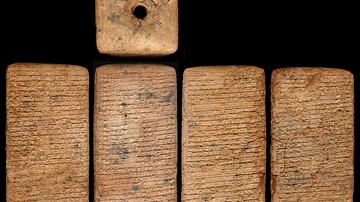
Kesh Temple Hymn
The Kesh Temple Hymn (c. 2600 BCE) is the oldest work of literature in the world, sometimes referenced as the oldest extant religious poem. It is a Sumerian praise song to the goddess Ninhursag and her temple in the city of Kesh, composed...

Article
Gilgamesh, Enkidu, and the Netherworld
Gilgamesh, Enkidu, and the Netherworld is a Sumerian poem pre-dating The Epic of Gilgamesh and featuring its central characters. It is sometimes included in modern-day translations as Book 12 but is usually omitted as it does not fit the...

Article
Francis Drake's Circumnavigation of the Globe
The English mariner, privateer, and explorer Francis Drake (c. 1540-1596 CE) made his circumnavigation of the world between 1577 and 1580 CE. Only the second to achieve this feat after the expedition of the Portuguese explorer Ferdinand Magellan...

Article
The Nebra Sky Disk - Ancient Map of the Stars
The Nebra Sky Disk is one of the most fascinating, and some would say controversial, archaeological finds of recent years. Dated to 1600 BCE, this bronze disk has a diameter of 32cm (about the size of a vinyl LP) and weighs around 2 kg. It...

Article
Fortifications in Ancient Chinese Warfare
While ancient Chinese warfare was often characterised by large armies in pitched battles, siege warfare and the sacking of cities were also regular features. Huge earth walls with towers and encircling ditches or moats became the normal strategy...

Article
Chola Art & Architecture
Like many great civilisations, the origins of the Chola, a Tamil Hindu dynasty in southern India, are shrouded in the temporal mists of uncertainty and obscurity. It is however known that they were influential from at least the 3rd century...

Article
Tsul'kălû', The Slant-Eyed Giant
Tsul'kălû', The Slant-Eyed Giant is a myth of the Cherokee nation and is among the most popular. The legend relates the story of the great giant, Tsul'kălû', his marriage to a Cherokee maiden, and how the people broke trust with him so that...

Article
Elephants in Hellenistic History & Art
Elephants were thought of as fierce and frightful monsters in antiquity, very real though rarely seen until the Hellenistic period. They were deployed on the battlefield to strike terror into the enemy, however, since fear was considered...

Article
Lokasenna
The poem Lokasenna belongs to the Poetic Edda, a bulk of Old Norse poetry written down in Iceland in the 1200s but based on linguistic features dating back as far as the 900s. In this invaluable resource for Norse mythology, Lokasenna stands...

Article
Hidatsa Sun Dance Ritual
The Hidatsa Sun Dance Ritual (also known as Hidatsa Sun Dance) is a Native American story of the Hidatsa nation illustrating the practice of an individual initiating the Sun Dance for personal reasons, in this case, to win the hand of the...
