
Search
Remove Ads
Advertisement
Search Results

Article
Key German Weapons of World War I
Superior weapons can win wars, and during the First World War (1914-18) all sides attempted to gain an advantage over the enemy by producing more and more destructive devices that could be used effectively on land, at sea, and in the air...

Article
Key British Weapons of World War I
The First World War (1914-18) witnessed an arsenal of new weapons as all sides were desperate to gain an advantage, particularly in the static trench warfare of the Western Front. There were some old tried-and-tested weapons like the Lee-Enfield...
Article
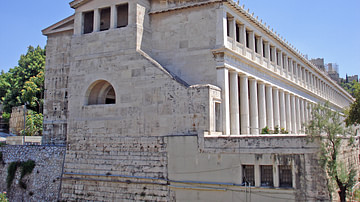
Athens in the Hellenistic World
When we think about ancient Athens, it is almost always about the classical city. We think of such things as its numerous monuments (the Parthenon on the Acropolis for example), beautifying everywhere, the Agora swarming with people doing...

Article
Origins of World Agriculture
Agriculture arose independently at several locations across the world, beginning about 12,000 years ago. The first crops and livestock were domesticated in six rather diffuse areas including the Near East, China, Southeast Asia, and Africa...

Interview
Interview: King of the World by Matt Waters
In this interview, World History Encyclopedia sits down with author Matt Waters to chat about his new book King of the World: The Life of Cyrus the Great published by Oxford University Press. Kelly: Can you tell us a bit about your book...

Article
Women in World War I - Changing Roles & Rights
During the First World War (1914-18), as governments sought to field the largest armies possible and so conscripted millions of men to the fighting fronts, the role of women in society was greatly expanded. Women worked as nurses and medical...

Definition
The Ancient City
In the study of the ancient world a City is generally defined as a large populated urban center of commerce and administration with a system of laws and, usually, regulated means of sanitation. This is only one definition, however, and the...

Article
How Germany Lost World War I
Germany started the First World War (1914-18) with the belief its armed forces could win a quick and decisive victory over France and then Russia. The reality turned out to be much more complicated as more countries became involved in a global...

Article
Graf Zeppelin's Round the World Trip of 1929
The Graf Zeppelin was the most successful of all Zeppelin airships, making several hundred trips across the Atlantic between Europe and the Americas. In 1929, a new age of air travel dawned when the Graf Zeppelin flew around the world in...

Article
Trade in the Phoenician World
The Phoenicians, based on a narrow coastal strip of the Levant, put their excellent seafaring skills to good use and created a network of colonies and trade centres across the ancient Mediterranean. Their major trade routes were by sea to...
