
Search
Remove Ads
Advertisement
Search Results
Image
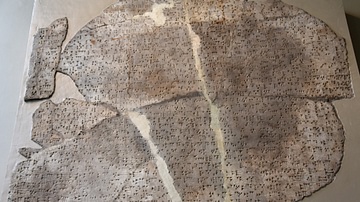
Door Slab from the Central Palace, Nimrud
These cuneifrom inscriptions describe some of the military campaigns of the Assyrian king Tiglath-pileser III (reigned 744-727 BCE) and were probably first placed in a doorway of the Central Palace built by...

Definition
Chlothar II
Chlothar II was a Merovingian king of the Franks, who reigned from 584 to 629. He inherited the throne of Neustria as an infant, upon the assassination of his father, Chilperic I (r. 561-584). Following a long and bitter power struggle...

Image
Palace of Darius in Susa
The foundations of the Palace of Darius the Great at Susa (Iran), the capital of Elam and of the Achaemenid Empire. The palace was built on a 12-hectare (29.6 acres) artificial platform and occupied five hectares (12.3...

Image
Dungur Palace, Aksum, Ethiopia - Reconstruction
Dungur Palace is in the Ethiopian village of Aksum—once the bustling capital of an African empire that stretched from southern Egypt to Yemen. The 6th-century mansion contains approximately 50 rooms, including...
Image
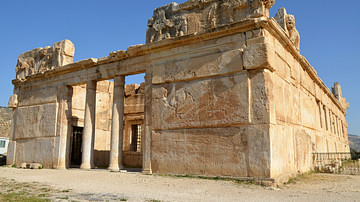
Hellenistic Palace Qasr Al-Abd
Qasr Al-Abd is a Hellenistic palace dating from approximately 200 BCE whose ruins stand in western Jordan, approximately 17 kilometers west of Amman. It is a two-story stone structure (measuring about 40 meters by...
Image
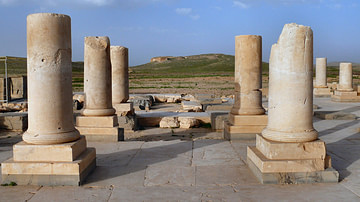
Pasargadae Palace
Cyrus the great's private palace at Pasargadae. This palace is one of the two first builded in the emerging capital of the founder of the new persian empire. Before Pasargadae, the persian who were nomadic shepperds, had no real...
Image
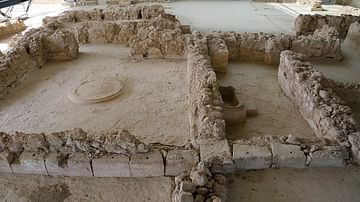
Palace of Nestor Ruins
Ruins of the Palace of Nestor at Pylos showing the preserved and decorated hearth and bathtub. The palace dates to c. 1300-1200 BCE
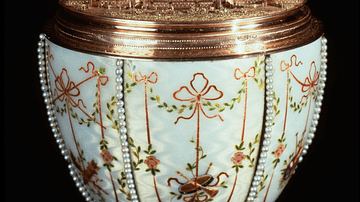
Image
Gatchina Palace Egg by Fabergé
The 1901 Gatchina Palace Egg by Peter Carl Fabergé (1846-1920). The egg was given by Tsar Nicholas II (r. 1894-1917) to his mother the Empress Dowager Marie Feodorovna. The egg is made of gold and white enamel with...
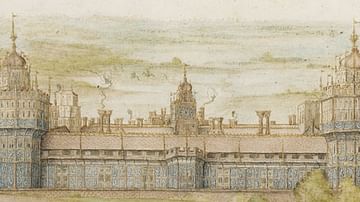
Image
Nonsuch Palace
A 1568 CE watercolour by Georg Hoefnagel of Nonsuch Palace, Surrey. The palace was built as a pleasure residence for Henry VIII of England (r. 1509-1547 CE) from 1538 CE. It was demolished in the 17th century CE.

Image
Egyptian sphinx from Diocletian's Palace
Diocletian's Palace was decorated with numerous granite sphinxes originating from the site of Egyptian Pharaoh Thutmose III. Only three have survived the centuries. This one is still located on the Peristyle...
