
Search
Did you mean: Dido?
Remove Ads
Advertisement
Search Results

Article
The Nebra Sky Disk - Ancient Map of the Stars
The Nebra Sky Disk is one of the most fascinating, and some would say controversial, archaeological finds of recent years. Dated to 1600 BCE, this bronze disk has a diameter of 32cm (about the size of a vinyl LP) and weighs around 2 kg. It...

Definition
Phaistos Disk
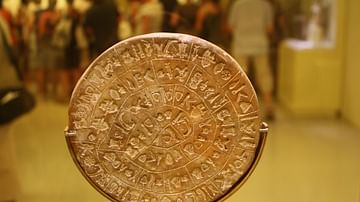
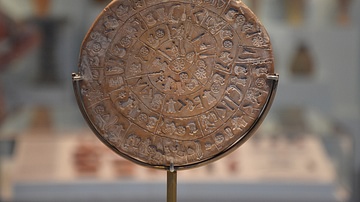
The Phaistos disk is a fired clay disk, probably of Minoan origin, measuring some 16cm in diameter and impressed on both sides with 242 symbols set in a spiral arrangement. As yet, this unique archaeological find remains an undeciphered enigma...

Image
Disk of Enheduanna
The Disk of Enheduanna, found in a chamber of the Larsa temple of Nin-Gal, dated to 2350-2300 BCE.
Penn Museum, Philadelphia.
Image
Phaistos Disk
One side (A) of the Phaistos disk, New-Palace period (1600-1450 BCE), Heraklion Archaeological Museum, Crete,
Each side of the clay disk is impressed with hieroglyphic symbols as yet undeciphered.

Definition
Faravahar
The faravahar is the best-known symbol from ancient Persia of the winged sun disk with a seated male figure in the center. It is thought to represent Ahura Mazda, the god of Zoroastrianism, but has also been interpreted to signify other concepts...
Image
Phaistos Disk (Side B)
One side (B) of the Phaistos Disk, New-Palace period (1600-1450 BCE). Heraklion Archaeological Museum, Crete,
Image
Phaistos Disk
The side A of the Phaistos disk, New-Palace period (1600-1450 BCE), Heraklion Archaeological Museum, Crete.
Image
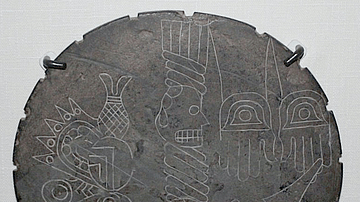
Willoughby Disk, Moundville
The Willoughby Disk, an engraved stone disk from Moundville, Hale County, Alabama, USA. The site dates to c. 1100 - c. 1450 CE. (Jones Archaeological Museum, Moundville).
Image
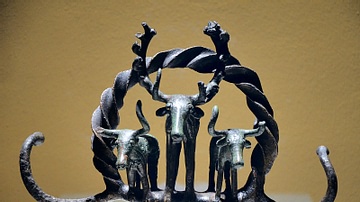
Hattian Sun Disk
Bronze Age Hattian ceremonial standard known as "Sun Disks" with two bull and a deer, the sacred animals of the Hattians. These objects were used in religious ceremonies and were found in the royal tombs of Hattian times unearthed in Alacahöyük...

Video
Akhenaten, the Sun Disk and the Amarna Period of Egypt
Akhenaten (who was born Amenhotep IV), is best known for his radical changes during his reign like elevating Aten the Sun Disk to the supreme deity, and moving the capital of Ancient Egypt to Amarna, a site which has given its name to the...
