
Search
Did you mean: Delphi?
Remove Ads
Advertisement

 This answer was generated by
 Search Results

Definition
Delhi Durbar
The Delhi Durbar was a spectacular public event held in India to commemorate the accession of a new British monarch to the title Empress or Emperor of India. Three Delhi Durbars were held: 1877, 1903, and 1911. The event involved...
Image
Delhi Durbar 1911
A photograph showing the royal platform and parading troops during the Delhi Durbar of December 1911. The durbar was held as an opportunity for rulers of Indian princely states to pay homage to the British Crown, in this case...
Definition
Tughlaq Dynasty
The Tughlaq dynasty (also spelt Tughluq), ruled the Delhi sultanate from 1320 to 1413. Followed by the Khalji dynasty and preceded by the Sayyids, the Tughlaq dynasty formed an important period in the history and culture of the...

Image
Map of the Rise of the Delhi Sultanate: The Mamluk Period - From Slave Commanders to Sultans
The Delhi Sultanate under the Mamluk (or “Slave”) Dynasty (1206–1290) marked the consolidation of centralized Muslim rule in northern India following the fragmentation...

Image
Map of the Delhi Sultanate under the Tughlaqs
A map showing the extent of the Delhi sultanate under the Tughlaq dynasty in the 14th century,

Image
The Recapture of Delhi
A coloured lithograph by Bequet Freres showing the British recapture of Delhi in September 1857 during the Sepoy Mutiny (1857-8). (National Army Museum, England)
Image
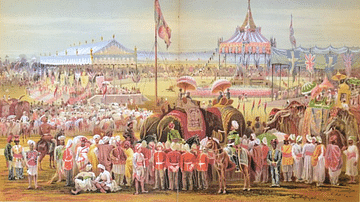
1877 Delhi Durbar
An illustration of the procession of Indian princes at the Delhi durbar of 1877, held to commemorate Queen Victoria (r. 1837-1901) being proclaimed Empress of India.
Image
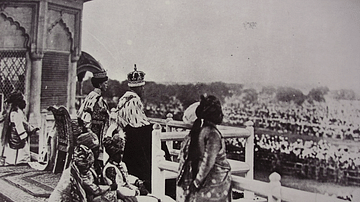
George V & Queen Mary at the Delhi Durbar
A photograph showing King George V (r. 1910-1936) and Queen Mary of Teck at the Delhi Durbar of 1911.
Image
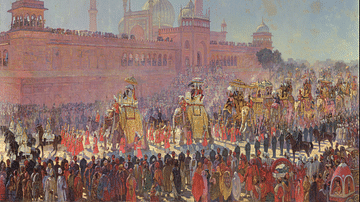
1903 Delhi Durbar
An illustration of the elephant procession at the Delhi Durbar of 1903. The durbar marked the accession of King Edward VII (r. 1900-1910).

Image
Iron Pillar of Delhi
The Iron Pillar in Qutub Complex, Delhi is a stellar example of advanced metallurgy technology in Gupta Period (circa 320 - 550 CE). The 7 m (23 ft) high pillar was made corrosion resistant. It bears Sanskrit - Brahmi inscriptions...
