
Search
Did you mean: Nanshe?
Search Results

Definition
Germanicus
Germanicus (15 BCE - 19 CE) was a commander in the Roman Empire with a glowing reputation in his time under the rule of the Emperor Tiberius. His position in the Roman Empire was a unique and important one. His marriage to Agrippina the Elder...

Definition
Cniva - The Goth King Who Defeated Rome
Cniva (also given as Kniva, reign circa 250 to possibly 270) was the king of the Goths who defeated Emperor Decius (reign 249-251) at the Battle of Abritus in 251. Little is known of him other than his campaign in 251, in which he successfully...
Definition
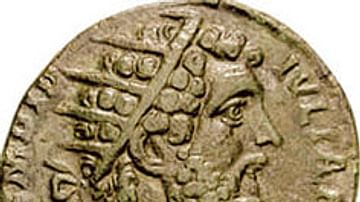
Didius Julianus
Didius Julianus was Roman emperor from March to June 193 CE. On March 28, 193 CE Roman Emperor Pertinax was assassinated by the Praetorian Guard, and like his predecessor Commodus, he left no apparent successor. Two possible claimants presented...

Definition
John I Tzimiskes
John I Tzimiskes was Byzantine emperor from 969 to 976 CE. Although he took the throne by murdering his predecessor Nikephoros II Phokas, John was a popular emperor. A skilled general and a competent politician, he is known for expanding...

Definition
Salona
Salona was an ancient city located at the estuary of the river Jadro in present-day Solin, a suburb of Split on the Adriatic coast of Croatia. It became the capital of the Roman province of Dalmatia in 9 CE. Before the Romans Salona was...
Definition
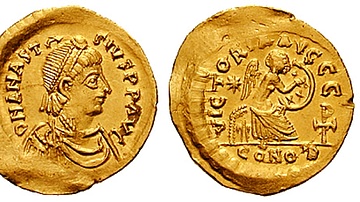
Anastasios I
Anastasios I ruled the Byzantine empire from 491 to 518 CE. Although his tax and monetary reforms were both popular and successful, the emperor could not repair the damaging split in the Christian Church created by his predecessors. He faced...
Definition
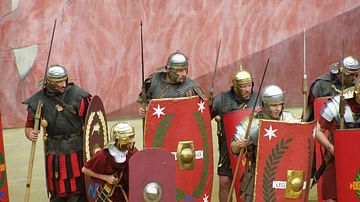
Legio I Adiutrix
Legio I Adiutrix was a legion of the Roman army formed from veteran sailors after the death of Roman emperor Nero (r. 54-68 CE). During its long career, the legion accompanied Trajan (r. 98-117 CE) on his Dacian and Parthian campaigns, fought...
Definition
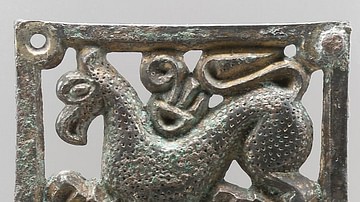
Bayan I
Bayan I (reigned 562/565-602 CE) was a king of the Avars, a confederation of heterogeneous people who migrated from the region of Mongolia, north of China, in 552 CE and came in contact with the Eastern Roman Empire c. 557 CE. Bayan I is...

Article
Fall of the Western Roman Empire
To many historians, the fall of the Western Roman Empire in the 5th century CE has always been viewed as the end of the ancient world and the onset of the Middle Ages, often improperly called the Dark Ages, despite Petrarch's assertion. Since...

Article
Trade in Ancient Celtic Europe
Trade in raw materials and manufactured goods in ancient Celtic Europe was vibrant and far-reaching, particularly regarding the centre of the continent where there was a hub of well-established trade routes. As the Celts' territory expanded...
