
Search
Search Results

Definition
Nisaba
Nisaba (also Naga, Se-Naga, Nissaba, Nidaba, and associated with Nanibgal) is the Sumerian goddess of writing, accounts, and scribe of the gods. Although her name is commonly given as Nidaba, noted scholar Jeremy Black points out that "the...

Video
The birth of writing! - History of Writing Systems #2 (Pictographs in a cave)
Writing started out as pictures? Yep! Journey to a cave full of pictographs in ancient France and see how it all began. You just took Thoth's Pill. Now watch as early cave paintings turn into pictographs and ideographs. Where will history...

Article
Mesopotamian Education - Creating the First Written Works in History
Mesopotamian education was invented by the Sumerians following the creation of writing circa 3600/3500 BCE. The earliest schools were attached to temples, but later schools were established in separate buildings, in which the scribes of ancient...

Definition
Seshat
Seshat (also given as Sefkhet-Abwy and Seshet) is the Egyptian goddess of the written word. Her name literally means "female scribe" and she is regularly depicted as a woman wearing a leopard skin draped over her robe with a headdress of...

Interview
Weavers, Scribes, and Kings: A New History of the Ancient Near East with Amanda H. Podany
In this interview, World History Encyclopedia sits down with author and Assyriologist Amanda H. Podany to learn all about her new book Weavers, Scribes, and Kings: A New History of the Ancient Near East published by Oxford University Press...

Article
Mesopotamian Inventions - Creating the Future
Mesopotamian inventions include many items taken for granted today, most of which were created during the Early Dynastic period (circa 2900-2350/2334 BCE) or developed from achievements of the Uruk period (circa 4000-3100 BCE). The Sumerians...

Image
Cuneiform Synonyms List
Occasionally, cuneiform text scribes encounter difficult or rare words. The list on this clay tablet explain such words. From the library of Ashurbanipal at Nineveh (modern-day Ninawa Governorate, Iraq), northern Mesopotamia. Neo-Assyrian...
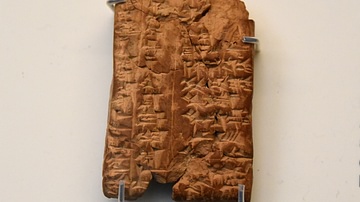
Image
Aramaic Alphabet written in Cuneiform Signs
This is a classroom experiment. As Babylon grew, the language spoken on its streets changed. This remarkable tablet captures interaction between the age-old cuneiform writing for Babylonian Akkadian and the alphabetic Aramaic that ultimately...
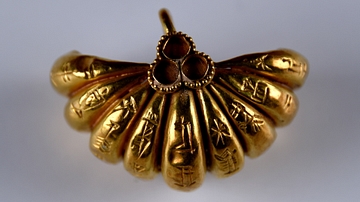
Image
Cuneiform, Gold Earring from Ur III
This is the upper surface of the earring. Note how the cuneiform signs were carved and distributed and their distance from the center. The cuneiform text is read vertically, from the upper surface downwards on each segment, and it continues...

Article
A Supervisor's Advice to a Young Scribe
A Supervisor's Advice to a Young Scribe is a Sumerian composition relating a dialogue between an elder scribe and a young graduate from his school. The piece is dated to the Old Babylonian Period (c. 2000-1600 BCE) and, although originally...
