
Search
Remove Ads
Advertisement
Search Results

Definition
Inca Civilization
The Inca civilization flourished in ancient Peru between c. 1400 and 1533 CE. The Inca Empire eventually extended across western South America from Quito in the north to Santiago in the south. It was the largest empire ever seen...

Definition
Dur-Sharrukin
Dur-Sharrukin (modern Khorsabad, Iraq) was a city built by Sargon II of Assyria (r. 722-705 BCE) as his new capital between 717-706 BCE. The name means Fortress of Sargon and the building project became the king's near obsession...

Definition
Ghosts in the Ancient World - The Return of the So-Called Dead
A belief in an afterlife was central to every major civilization of the ancient world and this encouraged the recognition of the reality of ghosts as the spirits of the departed who, for one...

Definition
Hindu Architecture
Hindu architecture evolved over the centuries from simple rock-cut cave shrines to massive and ornate temples which spread across the Indian sub-continent and beyond, forming a canonical style which is still adhered to today...

Definition
Inca Warfare
The warfare of the Inca civilization was characterised by a high degree of mobility, large-scale engagements of hand-to-hand combat, and the establishment of a network of fortresses to protect an empire of over 10 million subjects...

Definition
Silla
The Silla kingdom ruled south-eastern Korea during the Three Kingdoms period from the 1st century BCE to 7th century CE. The capital was Geumseong (Gyeongju) with a centralised government and hierarchical system of social ranks. The prosperity...

Definition
Nergal - The Mesopotamian God of Death, War, and Destruction
Nergal (also known as Erra and Irra) is the Mesopotamian god of death, war, and destruction. He began as a regional, probably agricultural, god of the Babylonian city of Kutha in the Sumerian...
Definition
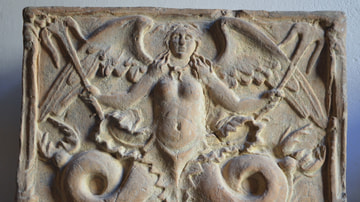
Ancient Volterra
Volterra (Etruscan name: Velathri, Roman: Volaterrae), located in the northern part of Tuscany, Italy, was an important Etruscan settlement between the 7th and 2nd century BCE. After its destruction by the Romans in the 1st century...

Definition
Long Barrow
A long barrow is a class of Middle Neolithic (approximately 3500-2700 BCE) burial monument which is found extensively throughout the British Isles and is related to other forms of contemporary tomb-building traditions of north-western...

Definition
Brundisium
Brundisium (modern Brindisi), located on the Adriatic coast of southern Italy, was a Messapian and then Roman town of great strategic importance throughout antiquity. Although architectural remains are sparse, the city has several...
