
Search
Did you mean: Rhodes?
Remove Ads
Advertisement
Search Results

Article
Twelve Greatest Illuminated Manuscripts
Illuminated manuscripts are, as their name suggests, hand-made books illumined by gold and silver ink. They were produced in Western Europe between c. 500 and c. 1600 CE and their subject matter is usually Christian...
Article
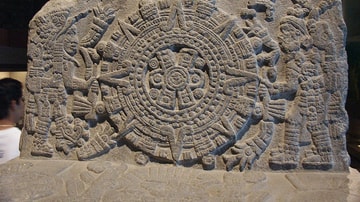
The Aztec New Fire Ceremony
The New Fire Ceremony, also known as the Binding of the Years Ceremony, was a ritual held every 52 years in the month of November on the completion of a full cycle of the Aztec solar year (xiuhmopilli). The purpose of...

Article
Maya Writing
The Maya hieroglyphic writing system was a sophisticated combination of pictographs directly representing objects and ideograms (glyphs) expressing more abstract concepts such as actions, ideas and syllabic sounds. Maya writing has...

Article
Day of the Dead
The Day of the Dead, known in Spanish as Día de los Muertos, is a holiday that celebrates life and honors the dead through traditions, food, decorations, and activities intended to sustain the connections between the living and...

Article
The Mask of Xiuhtecuhtli
The striking turquoise mask now in the British Museum in London is thought to represent Xiuhtecuhtli, the Aztec god of fire, and dates to the final century of the Aztec empire, c. 1400-1521 CE. It is made from hundreds...

Article
Viking Prophecy: The Poem Völuspá of the Poetic Edda
The Völuspá (Old Norse: Vǫluspá) is a medieval poem of the Poetic Edda that describes how the world might have come into shape and would end according to Norse mythology. The story of about 60 stanzas...

Article
Hildegard of Bingen's Unknown Language and Unknown Letters
Sometime in 1153 or 1154, the German nun Hildegard of Bingen (1098-1179) wrote a letter to the elderly Pope Anastasius IV (1073-1154). Her words were scathing. She called the pope tired and criticized...

Article
Lokasenna
The poem Lokasenna belongs to the Poetic Edda, a bulk of Old Norse poetry written down in Iceland in the 1200s but based on linguistic features dating back as far as the 900s. In this invaluable resource for Norse mythology, Lokasenna...

Article
Banking in the Roman World
Just as in other ancient civilizations, the first banks in Rome began in the temples consecrated to the ancient Gods. Many temples held in their basements the Romans' money and treasure, and were involved in banking activities...

Article
Hanno: Carthaginian Explorer
In the 5th century BCE, the Carthaginian explorer Hanno sailed beyond the Pillars of Hercules, out of the Mediterranean and into hitherto unknown territory down the Atlantic coast of Africa. In his search to find new...
