
Search
Remove Ads
Advertisement
Search Results

Definition
Chinese Literature
Chinese literature is among the most imaginative and interesting in the world. The precision of the language results in perfectly realized images whether in poetry or prose and, as with all great literature, the themes are timeless...

Article
Crossbows in Ancient Chinese Warfare
The crossbow was introduced into Chinese warfare during the Warring States period (481-221 BCE). Developing over the centuries into a more powerful and accurate weapon, the crossbow also came in versions light...

Article
The Civil Service Examinations of Imperial China
The civil service examinations of Imperial China allowed the state to find the best candidates to staff the vast bureaucracy that governed China from the Han Dynasty onwards (206 BCE - 220 CE). The exams...

Definition
Ancient Chinese Art
Ancient China covered a vast and ever-changing geopolitical landscape, and the art it produced over three millennia is, unsurprisingly, just as varied. Still, despite continuous indigenous technical developments, changes in...

Definition
Lao-Tzu
Lao-Tzu (l. c. 500 BCE, also known as Laozi or Lao-Tze) was a Chinese philosopher credited with founding the philosophical system of Taoism. He is best known as the author of the Laozi (later retitled the Tao-Te-Ching translated as “The...

Definition
Chinese Writing
Ancient Chinese writing evolved from the practice of divination during the Shang Dynasty (1600-1046 BCE). Some theories suggest that images and markings on pottery shards found at Ban Po Village are evidence of an early writing...

Definition
Yayoi Period
The Yayoi Period is one of the oldest historical periods of Japan spanning from c. 300 BCE to c. 250 CE, preceded by the Jomon Period and followed by the Kofun Period. The name Yayoi comes from the district in Tokyo where the first...

Definition
Edo Period
The Edo period refers to the years from 1603 until 1868 when the Tokugawa family ruled Japan. The era is named after the city of Edo, modern-day Tokyo, where the Tokugawa shogunate had its government. It is also sometimes referred...

Article
Eunuchs in Ancient China
Eunuchs were powerful political players in ancient Chinese government. Originating as trusted slaves in the royal household they were ambitious to use their favoured position to gain political power. Advising the emperor...
Image
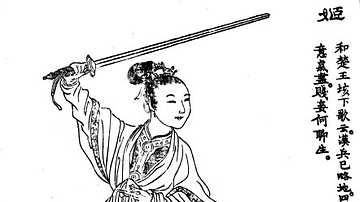
Consort Yu
Artistic rendering of Consort Yu (also Yuji, born Yu Miaoyi), the young concubine of Xiang Yu, King of Chu (r. 206-202 BCE). She was captured in one of the skirmishes of the Chu-Han Contention (206-202 BCE) in which the forces of...
