
Search
Remove Ads
Advertisement
Search Results

Definition
Vidar
Vidar is a figure in Norse mythology, described as the silent god and almost as mighty as Thor. He will survive Ragnarök, the unavoidable and dramatic end of the world according to the prophecy that chief-god Odin extracts from a seeress...

Image
Caratacus Paraded in a Roman Triumph
Caractacus Led in Triumph Through Rome, lithographic print by John Linnell the Younger after the cartoon by George Frederick Watts, 1847. Caratacus (or Caractacus) was a Briton chieftain who made war against the invading legions of the Roman...

Article
Early Muslim Conquests (622-656 CE)
Islam arose as a religious and socio-political force in Arabia in the 7th century CE (610 CE onwards). The Islamic Prophet Muhammad (l. 570-632 CE), despite facing resistance and persecution, amassed a huge following and started building...

Article
Women in the Viking Age
Although women in the Viking Age (c. 790-1100 CE) lived in a male-dominated society, far from being powerless, they ran farms and households, were responsible for textile production, moved away from Scandinavia to help settle Viking territories...
Article
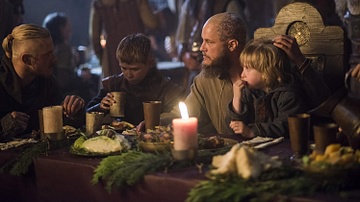
Norse-Viking Diet
In many depictions of Vikings, whether in film or other media, a group is often seen gathered around a flaming pit while an animal of some type – usually a boar – turns on a spit above. While the people of Scandinavia certainly ate meat...

Article
Battles & Conquests Of The Ottoman Empire (1299-1683)
Spanning across three continents and holding dominance over the Black and Mediterranean Seas, the Ottoman Sultanate (1299-1922) was a global military superpower between the 15th and 17th centuries. From the point of its inception in 1299...

Article
Seven Notorious Women Pirates
In this article, we look at the lives and deeds of seven notorious women pirates. There is Teuta, the Balkan enemy of ancient Rome; Alwilda, the Scandinavian princess who chose a life of crime on the High Seas; Maria Lindsey, who terrorized...

Article
Hei Tiki
The hei tiki is a small personal adornment, fashioned by hand from tough pounamu (New Zealand greenstone or nephrite jade), and is worn around the neck. Hei means something looped around the neck, and tiki is a generic word used throughout...

Article
Battle of Queenston Heights
The Battle of Queenston Heights (13 October 1812) was a major battle in the War of 1812. A US army, under General Stephen Van Rensselaer, crossed the Niagara River in an attempted invasion of Canada but was repulsed by a British, Canadian...

Article
The Mutual Destruction of Sennacherib & Babylon
The reign of Assyrian king Sennacherib (705-681 BCE) was chiefly characterized by his difficulties with Babylon. Throughout the history of the Assyrian Empire, Babylon had caused problems and had even been destroyed by the Assyrian king Tukulti-Ninurta...
