
Search
Did you mean: Sulla?
Remove Ads
Advertisement

 This answer was generated by
 Search Results

Article
Sicilian Temples (Greek Metrology)
Characteristics of Sicilian Archaic Temples The large dimensions of the components, the presence of a propteron, an adyton, and other specific elements of the plan and elevation speak for an originally very autonomous development of Sicilian...

Image
Cella of Garni Temple in Armenia
The cella of Armenia's Garni Temple is about 7 m (23 ft) high, 8 m (26 ft) long, and 5 m (17 ft) wide. As it can only hold about 20-25 people inside, many historians and archaeologists believe it originally held a statue, perhaps of the sun...

Definition
Parthenon
The magnificent temple on the Acropolis of Athens, known as the Parthenon, was built between 447 and 432 BCE in the Age of Pericles, and it was dedicated to the city's patron deity Athena Parthenos. The temple was constructed to house the...

Article
Visitor's Guide to Ancient Dion
Dion is located at the foot of Mount Olympus in the north of Greece, in what would have been ancient Macedon. It takes its name from the most important Macedonian sanctuary dedicated to Zeus ("Dios” meaning "of Zeus”). Legend claims this...
Article
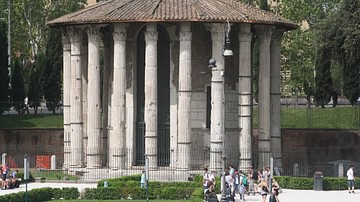
Temple of Vesta/Hercules, Rome
The Temple of Vesta is the popular name given to the round temple near the Tiber River in Rome (now Piazza Bocca della Veritá). The association with Vesta is due to the shape of the building but in fact it is not known to which god the temple...

Article
A Visual Glossary of Classical Architecture
Abacus - a large slab placed above the column capital to support the architrave or an arch placed above it. Akroterion - a decorative piece added to the roof of a temple at the apex and corners, usually made of clay or bronze and often in...
Article
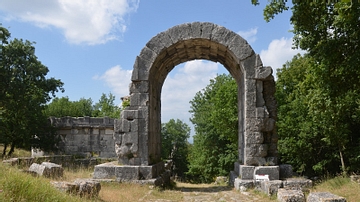
Visitor’s Guide to Carsulae (San Damiano)
Carsulae in Umbria, central Italy, was founded c. 300 BCE and only became a prosperous urban centre after it was connected by the Via Flaminia towards the end of the 3rd century BCE. It was granted the status of municipium and acquired a...

Definition
Erechtheion
The Erechtheion (or Erechtheum) is an ancient Greek temple constructed on the acropolis of Athens between 421 and 406 BCE in the Golden Age of the city in order to house the ancient wooden cult statue of Athena and generally glorify the great...
Definition
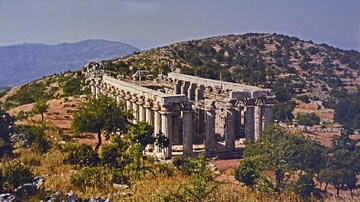
Bassae
Bassae (Bassai), located in south-west Arcadia on the slopes of Mt. Kotilion, was an important temple site in the Archaic and Classical periods. Its large 5th-century BCE temple of Apollo, now covered with a permanent roof, is one of the...

Definition
Naxos
Naxos, with an area of 430 km², is the largest island in the Cyclades archipelago. The island enjoyed its most prosperous periods in the early Bronze Age and again in the Archaic and Classical periods. Naxos in Mythology In certain versions...
