
Search
Did you mean: Hatti?
Remove Ads
Advertisement
Search Results

Definition
Indra - The Vedic Religion's Greatest God
The anthropomorphic god Indra was the most important god in the Vedic religion and he later became a major figure in Hinduism and an important deity in Buddhism, Cham and Chinese tradition. For the Aryas he was their national god and he was...

Article
Agriculture in the Fertile Crescent & Mesopotamia
The ancient Near East, and the historical region of the Fertile Crescent in particular, is generally seen as the birthplace of agriculture. The first agricultural evidence comes from the Levant, from where it spread to Mesopotamia, enabling...

Article
A History of Vaccination - Taming the World's Deadliest Diseases
The field of public health was transformed by the introduction of vaccination, from the Latin word “vacca” meaning cow, to guard people against infectious diseases. It was well known that exposure to infectious diseases and surviving them...

Article
The Mesopotamian Pantheon - The Ancient Gods and Goddesses of the Near East
The gods of the Mesopotamian region were not uniform in name, power, provenance or status in the hierarchy. Mesopotamian culture varied from region to region and, because of this, Marduk should not be regarded as King of the Gods in the same...

Article
Battle of Isandlwana - The Zulu Victory over the British Empire
The Battle of Isandlwana on 22 January 1879 was the opening encounter of the Anglo-Zulu War and a famous Zulu victory against the British Army. Over 25,000 Zulu warriors attacked and destroyed a British-led force of 1,700 men camped at the...

Article
Mesopotamian City Laments - Suffering And The Will Of The Gods
The question "Why do bad things happen to good people?" has been asked for millennia, probably since before writing was invented, but at least since circa 1700 BCE when the Sumerian (and later Babylonian) poem, Ludlul-Bel-Nemeqi (also known...

Article
Theophrastus and Pliny the Elder on Silphium
The silphium plant of Cyrene, valued as a seasoning, aromatic, and for its medicinal properties, is referenced by several notable ancient writers, but two of the best-known descriptions come from Theophrastus (l. c. 371 to c. 287 BCE) and...

Article
Herodotus on Animal Sacrifice in Egypt
II:38. The males of the ox kind they consider to belong to Epaphos, and on account of him they test them in the following manner: If the priest sees one single black hair upon the beast he counts it not clean for sacrifice; and one of the...

Article
The Home of the Fish
The Home of the Fish is a Sumerian poetic monologue, most likely from the Ur III Period (2047-1750 BCE), in which the speaker tries to coax various fish into a newly built home. The meaning of the poem depends on whether the speaker is sincere...
Image
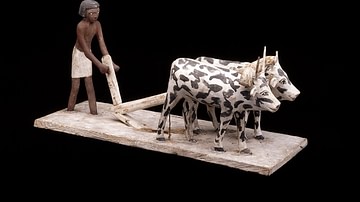
Wooden model of a man ploughing with oxen
From Egypt Middle Kingdom, about 2040-1750 BC An ancient Egyptian farmer at work This model was originally placed in a tomb. Models showing various stages in the production of food were placed in wealthy burials of the Middle Kingdom...
