
Search
Remove Ads
Advertisement
Search Results

Image
Scarab
Scarab shaped amulet containing the image and cartouche of Amenhotep III, promising its owner in this world 'life' (represented by an ankh). These beetle amulets were used in Ancient Egypt for rituals or administrative purposes (14th...
Image
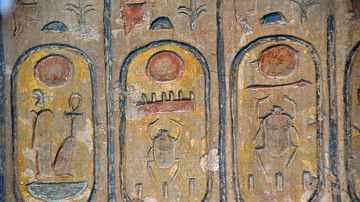
King-list of Egypt, Detail of the 18th Dynasty
A pharaoh was known primarily by his throne name. This was traditionally a statement about his divine father, the sun-god Ra, so all cartouches with throne names display a sun-god at the top. A king's birth...
Image
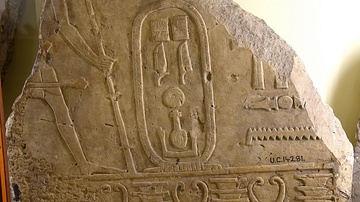
Slab of Pepi II king of Egypt
This limestone slab was found beneath the sand of the Ptolemaic temple at Kopyos (Qift). At the left side, the figure of the king Pepi II looks to the right. Before him, the rope-border cartouche containing the birth-name...

Image
Dahshur Decree of Pepi I
This is a detail of a large limestone fragment which came from the pyramid complex of the Egyptian pharaoh Sneferu (r. 2613 to 2589 BCE) of the 4th Dynasty of Egypt. This is one of the very few and important legal texts...
Image
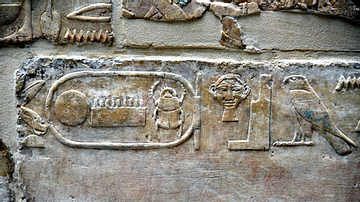
Prenomen of Thutmose III
This is a detail of a large limestone relief (showing a boat trip) that came from the Mortuary Temple of Hatshepsut at Deir el-Bahari, Egypt. The throne name (prenomen) cartouche of the Egyptian pharaoh Thutmose III (regined...

Image
Later Form of Aten Cartouches
Three cartouches from House 47.10 at Amarna, Egypt. New Kingdom, 18th Dynasty, c. 1340 BCE. The one on the left, smaller than the other two, is the prenomen (throne name) cartouche of the Egyptian pharaoh Akhenaten...
Image
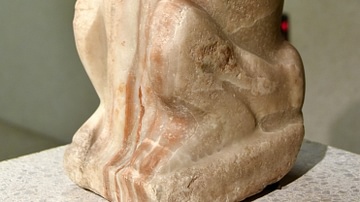
Male Baboon from Abydos
This calcite-alabaster almost life-size statue depicts a male baboon squatting on a base. The front part of the base was inscribed with hieroglyphic signs but they no longer discernible. However, a partially surviving Serekh...
Image
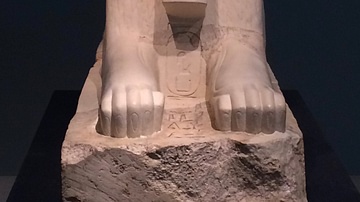
Sphinx of Maatkare Hatshepsut
This limestone and plaster piece depicts the female pharaoh Maatkare Hatshepsut as a sphinx. She has the body and mane of a lion, with the head of a human. Carved between the paws of the statue is a cartouche enclosing...
Image
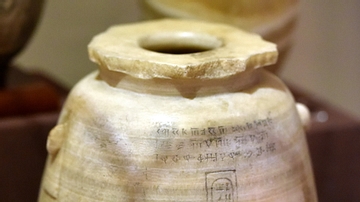
Jar of Xerxes I from Nimrud
This alabaster jar is inscribed with Elamite, Old Persian, and Neo-Babylonian cuneiforms. A cartouche of the Achaemenid king Xerxes I also appears. From Nimrud, in modern-day Ninawa Governorate, Iraq. Regin of Xerxes...
Image
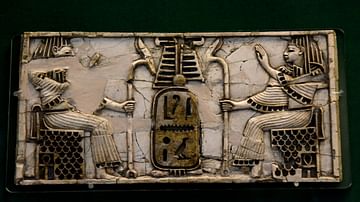
Nimrud Ivory Plaque of Two Seated Figures
Two figures sit facing each-other either side of a cartouche surmounted by two feathers. The inscription consisting of Egyptian hieroglyphs, cannot be read, the signs have been treated in a purely decorative...
