
Search
Remove Ads
Advertisement
Search Results
Definition
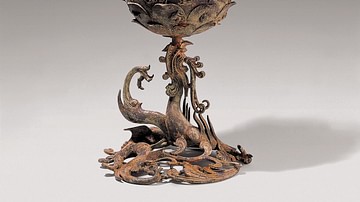
Baekje
Baekje (Paekche) was one of the Three Kingdoms which ruled over ancient Korea from the 1st century BCE to the 7th century CE. Controlling territory in the south-western part of the peninsula the kingdom was in constant rivalry with the...
Definition
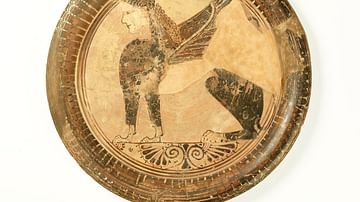
Naukratis
Naukratis (also spelled Naucratis, and known as Nokraji to the ancient Egyptians) was a city in Lower Egypt, located in the Canopic (or western) branch of the Nile delta, which became a powerful trading port between the Egyptians and...

Definition
Antinous
Antinous (l. c. 110-130 CE) was a youth of Bithynia who became the beloved of the Roman emperor Hadrian (l. 76-138 CE, r. 117-138 CE) from around the age of 13 until his death at nearly 20. His year of birth is unknown as are any details...
Definition
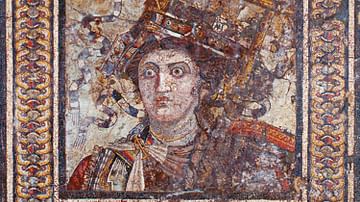
Berenice II Euergetis
Berenice II Euergetis (c. 267-221 BCE) was a pre-eminent Hellenistic queen, who ruled together with her husband Ptolemy III (r. 246-221 BCE), when the Ptolemaic kingdom was at the height of its power, dominating most of the...

Article
Cosmetics, Perfume, & Hygiene in Ancient Egypt
For the ancient Egyptians life was a celebration, and so, just as one would want to look one's best at any party, personal hygiene was an important cultural value. The Egyptians bathed daily, shaved their...

Article
The Art of the Han Dynasty
The art of the Han dynasty (206 BCE - 220 CE) of ancient China is characterised by a new desire to represent everyday life and the stories from history and mythology familiar to all. The arts were fuelled both by a political...

Article
The Admonitions of Ipuwer - A Tale of Chaos and the Importance of Government
The Admonitions of Ipuwer (also known as The Papyrus Ipuwer and The Admonitions of an Egyptian Sage) is a literary text dated to the Middle Kingdom of Egypt (2040-1782 BCE). The...
Article
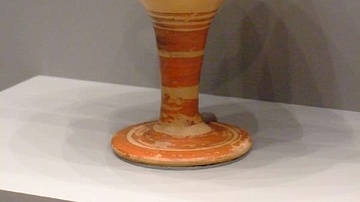
Mycenaean Pottery
The pottery of the Mycenaean civilization (1550-1050 BCE), although heavily influenced by the earlier Minoans based on Crete, nevertheless, added new pottery shapes to the existing range and achieved its own distinctive decorative...

Article
Women Scientists in the Scientific Revolution
Women scientists during the Scientific Revolution (1500-1700) were few in number because male-dominated educational institutions, as well as scientific societies and academies, barred women entry, meaning...

Article
Nazca Pottery
The pottery of the Nazca civilization, which flourished in ancient Peru between 200 BCE and 600 CE, is amongst the most distinctive art produced by any civilization from antiquity. Endlessly inventive both in form and in its use...
