
Search
Did you mean: Ull?
Remove Ads
Advertisement
Search Results
Image
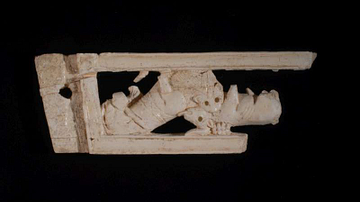
Lion & Bull in Combat Furniture Inlay
This object is an ivory furniture inlay depicting a lion and bull in combat. It was excavated from Samaria and dates to the Iron Age II (9th–8th Century BCE). (The Israel Museum, Jerusalem) Copyright of The Israel Museum, Jerusalem. Used...
Image
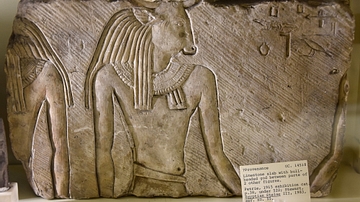
Egyptian Bull-headed deity
This limestone wall-relief block depicts a bull-headed god; the god has a human body and looks to the right side. He is standing between parts of two other partially shown figures. The background wall was left rough. From Egypt, precise provenance...

Image
Man-headed Bull, Gela
A silver coin depicting a man-headed bull from Gela, Sicily. 5th century BCE (Numismatics Museum, Athens)
Image
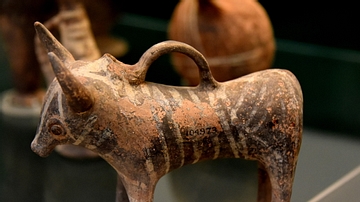
Imported Cypriot Pottery Bull to the Levant
During the Late Bronze Age, the trade contacts established with Cyprus in the preceding period were intensified. This type of bull was very popular in the Levant, either as ornaments or perhaps as feeding bottles. Base ring ware. LBI-II...
Image
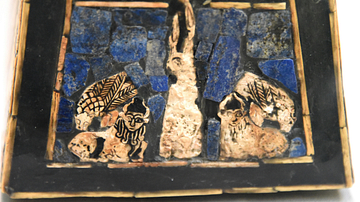
Human-Headed Bull in the Standard of Ur
This is one of the scenes depicted on one of the sides of the Standard of Ur; this is not part of the so-called "Peace and War Scenes" of the Standard. Here, at the center, there is what appears to be a tall tree, although its surface is...
Image
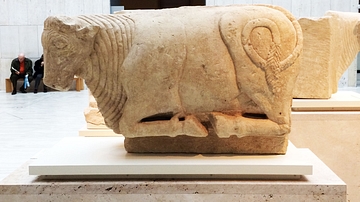
Iberian Bull Statue
This limestone statue of a bull comes from Osuna (Seville), Spain. It dates from the late 5th century CE. It was originally abutted to a funerary monument. Bulls were protectors of tombs, symbols of masculinity, and they were also associated...
Image
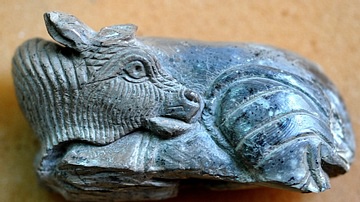
Nimrud Ivory Supine Bull
An exquisitely carved plaque of a supine bull. Note the black burn mark. Probably, this was part of a group which once supported an ivory tray. Neo-Assyrian period, 9th-7th centuries BCE. From Nimrud, Mesopotamia, Iraq. (The Sulaimaniya Museum...
Image
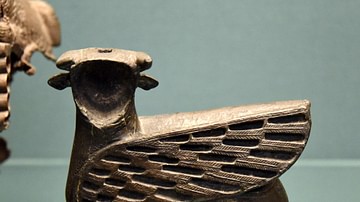
Kneeling Winged-Bull from Urartu
This is a bronze furniture-fitting (probably of a stool) of a kneeling or a recumbent winged-bull. It was originally inlaid and gilded. There is a dowel for attachment at the lower surface. From Toprakkale, Eastern Anatolia, in modern-day...
Image
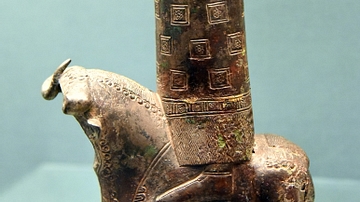
Standing God on a Bull from Urartu
This is a bronze furniture-fitting (probably of a corner of a throne or bed). A god wearing a fringed robe stands on a recumbent bull. It was originally inlaid and gilded. From Toprakkale, Eastern Anatolia, in modern-day Turkey. Urartian...
Image
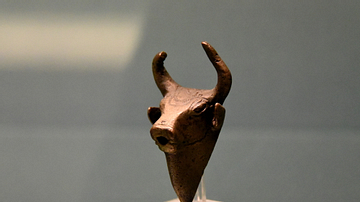
Urartian Bull's Head Spout
This bronze spout was shaped like a bull's head. The horns are curved and there is an ornamented forelock. From Urmia, north-western Iran. Urartian, 8th to 7th century BCE. (The British Museum, London).
