
Search
Remove Ads
Advertisement
Search Results

Image
Arts & Crafts Exhibition Society Season Ticket, 1890
The Arts and Crafts Exhibition Society was formed in London in 1887 to promote the exhibition of decorative arts alongside fine arts. The Society's exhibitions, which were held annually at the New...

Video
Ancient Roman Society and Social Order
Rome began as a small city on the banks of the Tiber River in Italy. The Latin tribes (also known as the Latini or Latians) inhabited the region c. 1000 BCE but the founding of the city is dated to 753 BCE. The...
Definition
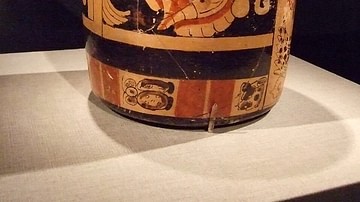
Chocolate in Mesoamerica
Chocolate was one of the most desired foods of Mesoamerica and was consumed by the Olmec, Maya, and Aztec civilizations, amongst others. Its consumption even spread via trade routes to other parts of the Americas including...

Video
What Montezuma's Aztec Sounded Like - and how we know
The Aztecs didn't call him Montezuma. Nor Moctezuma. They didn't call chocolate "chocolate". Heck, they didn't even call themselves Aztec! Though they were an oral culture, we have an idea of what...

Video
Aztec and Mayan Are Totally Different Languages. Sort of
Ancient Mexico was a hotbed of language mixing. Aztecs and Maya spoke completely unrelated languages, but a Mesoamerican linguistic mindmeld tied them together in surprising ways. Here's the grammar...

Image
Map of the Cradles of Early Civilization & Society - The First Centers of Agriculture, Complex Society & States
The pathways toward early civilization and complex society between c. 12,000 and 1000 BCE were neither uniform nor linear. After the end of the last Ice...

Image
Trade Union Scroll for the Amalgamated Society of Engineers
A trade union scroll for the Amalgamated Society of Engineers, created in January 1851. The scroll shows illustrations of important engineers and inventions during the Industrial Revolution...

Quiz
Government & Society in Ancient Rome
Roman Government society Consul Praetor Aedile Quaestor Censor Plebeians Patricians Equites Freedmen SPQR Tribal Assembly Centuriate Assembly The Senate The Tribune

Definition
Pedro de Alvarado
Pedro de Alvarado (c. 1485-1541) was a Spanish conquistador who became the first governor of Guatemala in 1527. Living an extraordinary life of adventure, Alvarado participated in separate expeditions to Mexico, Central America...

Video
The Aztec Myth of the Unlikeliest Sun God
Discover the myth of how the weak and pimply Aztec god Nanahuatl sacrificed himself to become Lord Sun and created a new world. — Nanahuatl, weakest of the Aztec gods, sickly and covered in pimples, had...
