
Search
Did you mean: Ife?

 This answer was generated by
 Search Results

Image
Axe-Based Production - Viking Ship Construction 18
At this stage, the saw had almost disappeared from the process of Viking shipbuilding, and production relied mainly on cleaving and axe hewing. Ship planks were made by opening the log along the grain and then shaping it with an axe. Charcoal...
Image
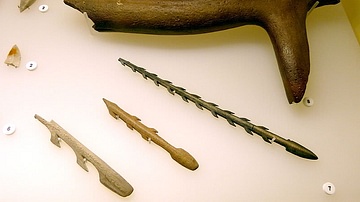
Mesolithic Harpoons & Lyngby Axe
Harpoons and Lyngby Axe (an axe made of antler) dated to around the 11th millennium BCE and belonging to the Mesolithic Age. It is on display at the Archaeological Museum of the state of Brandenburg in Germany.
Image
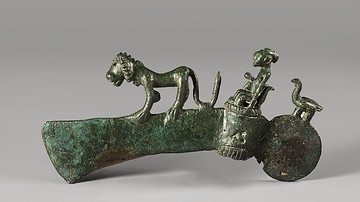
Bronze Axe Head Topped with a Man Ruling Animals from Western Iran
Bronze axe head topped with a man ruling animals, found in Saqqiz, Luristan, from Iron Age II (c. 1100-900 BCE). National Museum of Iran, Tehran. cc. no. 1434, photo by Neda Tehrani (Baloot Noghrei). Following the collapse of civilizations...

Image
Middle Palaeolithic Hand Axe
Hand axe from the site of Lyndford Quarry (near Mundford, Norfolk, UK), which dates to around 60,000 years ago and falls within the Middle Palaeolithic industry.
Image
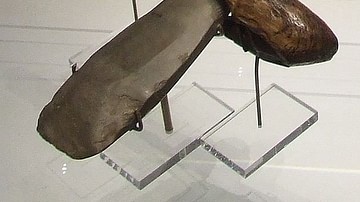
Neolithic Stone Axe with Wooden Handle
A Neolithic stone axe with a wooden handle, found at Ehenside Tarn. It is on display in the British Museum, London.
Image
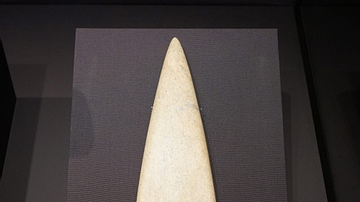
Stone Age Jade Axe
Jade, 5000-3600 BCE. Biebrich, Germany. This axe is made of European jade mined in prehistoric quarries in the Italian Alps. It appears to be an object of beauty rather than function. It would have taken several days to polish this jade...

Image
Stone Mould for Axes & Bronze Axe from Ancient Ireland
The stone mould, used for making flat and flanged axes, was found at Crannong, Loughscur, Co. Leitrim, Ireland. The bronze axe was found at Lisboy, Co. Meath, Ireland. Both date back to 2500-1700 BCE. National Museum of Ireland-Archaeology...
Image
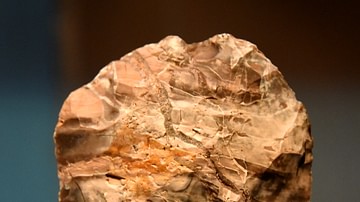
Flint Hand Axe
Paleolithic flint hand axe from modern-day Azraq, Jordan Hashemite Kingdom, 300,000-250,000 years BCE.
The Jordan Museum, Amman, Jordan.
Image
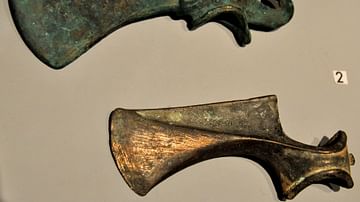
Bronze Shaft-Hole Axe
These two bronze shaft-hole axes date back to the late 3rd millennium BCE, Mesopotamia, Iraq. (The Sulaimaniya Museum, Iraq).
Image
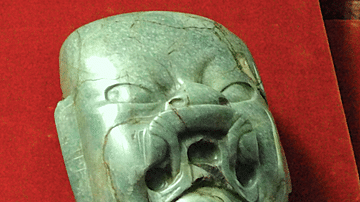
Kunz Axe
The Kunz Axe, a ceremonial axe-head or celt created by the Olmec civilization of Mesoamerica. Carved from jade. (Museum of Natural History, New York)
