
Search
Did you mean: Arsenale?
Remove Ads
Advertisement
Search Results
Image
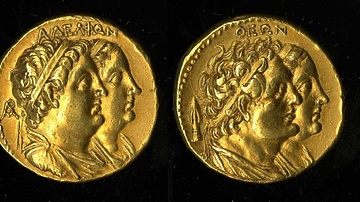
Ptolemy I with Berenice I & Ptolemy II with Arsinoe II
Gold octodrachm (mnaieion) with the draped and diademed jugate busts of siblings Ptolemy II and Arsinoe II on the reverse; Ptolemy I and Berenice I as their divine parents on the reverse. The legends over the portraits read Adelphōn (“of...

Image
Ptolemy II Before Arsinoe II
Limestone relief from the Chapel of Ptolemy II at Tanis in the Nile Delta representing Ptolemy II facing Arsinoe II (San el-Hagar, ca. 275-250 BCE; BM reg. no. 1885,1101.5, inv. no. EA-1056). Courtesy of the Trustees of the British Museum...
Image
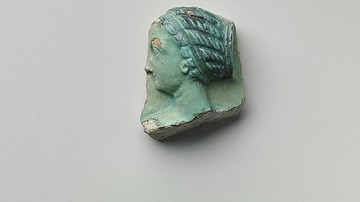
Faience Glass Vase Portraying Arsinöe II
This fragment of blue faience glass came from a kind of libation vessel known as "oinochoai" which were used in festivals honouring the deified Ptolemaic queens. The figure portrayed is Arsinöe II who wears her hair in the "melon-coiffure"...

Image
Arsinöe II
This limestone statue dates to 278-270 BCE and was found in the Memphite region of Egypt. Thought to portray the Ptolemaic queen Arsinöe II, the piece is an obvious callback to earlier Egyptian artistic motifs in an attempt to legitimize...

Definition
Ptolemaic Dynasty
The Ptolemaic dynasty was a Macedonian royal family that ruled Ptolemaic Egypt from 323 to 30 BCE. It was founded by Ptolemy I, a general and successor of Alexander the Great. They built Alexandria, including the Lighthouse of Alexandria...

Definition
Amastris
Amastris (c. 340/39-285 BCE) was a niece of the Persian king Darius III (r. 336-330 BCE) through her father Oxyathres. She was married in succession to Alexander's general Craterus, the tyrant Dionysius of Heraclea, and finally to Lysimachus...

Image
Liberation of Arsinoë
The Liberation of Arsinoë, depicting the Ptolemaic princess Arsinoë IV (left) being rescued by Ganymedes after she was imprisoned by Julius Caesar (100-44 BCE). Oil on canvas by Italian Renaissance artist Jacopo Tintoretto (1518-1594). Staatliche...
Definition
Ptolemy XIII Theos Philopator
Ptolemy XIII Theos Philopator (The Father-loving God, born 62/61 BCE, died 47 BCE) was pharaoh of Egypt from 51 BCE until his death. His reign began as co-ruler with his sister, the famous Cleopatra VII, following the wishes of their father...

Definition
Lysimachus
Lysimachus (c. 361-281 BCE) was one of Alexander the Great's trusted bodyguards and a member of his Companion Cavalry. Although he obtained Macedonian citizenship, his father was a Thessalian named Agathocles. After the death of Alexander...

Definition
Cleopatra VII - The Last Great Pharaoh of Ancient Egypt
Cleopatra VII (69-30 BCE, reign 51-30 BCE) was the last ruler of Egypt before it was annexed as a province of Rome. Arguably the most famous Egyptian queen, Cleopatra was ethnically Greek as a member of the Macedonian Ptolemaic Dynasty (323-30...
