
Search
Remove Ads
Advertisement
Search Results

Article
Roman Games, Chariot Races & Spectacle
If there was one thing the Roman people loved it was spectacle and the opportunity of escapism offered by weird and wonderful public shows which assaulted the senses and ratcheted up the emotions. Roman rulers...

Article
Ancient Greek Inventions
The ancient Greeks are often credited with building the foundations upon which all western cultures are built, and this impressive accolade stems from their innovative contributions to a wide range of human activities...

Article
Female Gladiators In Ancient Rome
Female gladiators in ancient Rome – referred to by modern-day scholars as gladiatrix – may have been uncommon but they did exist. Evidence suggests that a number of women participated in the public games of Rome...

Definition
Alexander I the Philhellene
Alexander I of Macedon, also known as Alexander I the Philhellene ('friend of the Greeks') or 'The Wealthy', was king of ancient Macedon from around 498 to 454 BCE. He is known for the role he played in the second Persian...

Article
The Athenian Calendar
The term “Athenian Calendar” (also called the “Attic Calendar”) has become somewhat of a misnomer, since Ancient Athenians never really used just one method to reckon the passage of time. Athenians, especially from the 3rd...
Definition
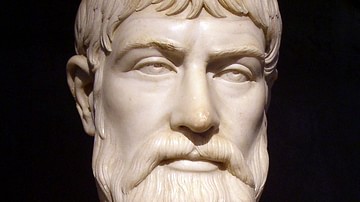
Pindar
Pindar (c. 518 to c. 448/7 BCE) was an ancient Greek lyric poet, probably the greatest of his time. His works have been divided into 17 books of different types of poetry, but only those containing 44 choral victory songs composed for...

Definition
Greek Archaic Period
The Greek Archaic Period (c. 800-479 BCE) started from what can only be termed uncertainty, and ended with the Persians being ejected from Greece for good after the battles of Plataea and Mykale in 479 BCE. The Archaic Period...

Image
Panathenaic Games Prize Amphora
Panathenaic Games prize amphora, terracotta vase decorated by the Euphiletos Painter, c. 530 BCE. The artwork on this vase is attributed to the Athenian artist known today as the Euphiletos Painter (c. 550 to c. 500...

Definition
Nemea
Nemea was a religious sanctuary in the northern Peloponnese of Greece where pan-Hellenic athletic games were held every two years from 573 BCE until 271 BCE, after which, the Games were definitively moved to Argos. Early Settlement...
Image
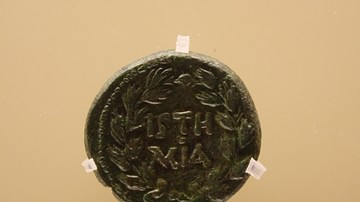
Coin Commemorating the Isthmian Games
A Greek coin commemorating the Isthmian Games. Corinth, 117-138 CE. (Numismatics Museum, Athens)
