
Search
Remove Ads
Advertisement
Search Results

Article
Depictions of India in Ancient Literature
Herodotus (484 BCE – c. 425 BCE) has been called the Father of History since he was the first historian known to collect his materials in detail, test their accuracy to a certain extent and arrange them in a well-constructed and vivid narrative...

Definition
Dutch East India Company
The Dutch East India Company (VOC) was formed in 1602 by the Staten-Generaal (States General) of the then Republic of the Seven United Netherlands. The company was granted a 21-year charter with rights to trade exclusively in Asia and to...
Image
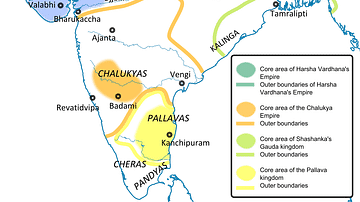
Ancient India in 625 CE
This is a political map of India showing the important kingdoms that existed around 625 CE. The predominant powers are the Pushyabhutis under Emperor Harshavardhana or Harsha (606-647 CE) in northern India, the (Vatapi) Chalukyas under Emperor...

Article
Trade Goods of the East India Company
The English East India Company (EIC) was founded in 1600, and it came to control both trade and territories in India, as well as a trade monopoly with China. Goods the EIC traded included spices, cotton cloth, tea, and opium, all in such...

Image
Ancient India in 590 CE
This is a political map of India showing the important kingdoms that existed around 590 CE after the disintegration of the Gupta Empire (3rd century CE to 6th century CE). The main players appear to be the Chalukyas in the south and the...
Article
Ancient Geography of India
The first text in Greek devoted entirely to India was written by Ctesias in the fourth century BCE. Only fragments of it survive. Yet he was probably the most widely quoted author on India, although Aristotle treated him with contempt. However...

Article
The Portuguese Conquest of India
Throughout the 15th century, the Portuguese Crown yearned for a piece of the Far Eastern spice trade. For centuries this trade had been dominated by the Venetians who obtained pepper, cloves, nutmeg, ginger and cinnamon from their Middle...

Definition
Indian Princely States
The Indian Princely states (aka Native States or Princely India) were those states in the Indian subcontinent the British did not conquer but which were typically bound by treaty first to the East India Company and then to the British Crown...

Article
The Armies of the East India Company
The East India Company (EIC) was first England's and then Britain's tool of colonial expansion in India and beyond. Revenue from trade and land taxes from territories it controlled allowed the EIC to build up its own private armies, collectively...

Image
The Four Castes of Ancient India - The Varna System
This infographic illustrates the Varna caste system in ancient India. First mentioned in the Rig Veda's Purusha Sukta c. 1200–1000 BCE, it shows society divided into four groups that emerged from the sacrifice of Purusha, a transcendent and...
