
Search
Remove Ads
Advertisement
Search Results

Image
Map of the Cities Named Alexandria by Alexander the Great - How One Name Marked the Map of Conquest
The urban foundations of Alexander the Great (Alexander III of Macedon, reign 336–323 BCE) formed a deliberate component of his imperial strategy during his campaigns...

Image
Alexander Sarcophagus (detail)
The Alexander Sarcophagus is a late 4th century BCE stone sarcophagus adorned with bas-relief carvings of Alexander the Great. The Alexander Sarcophagus is one of four massive carved sarcophagi, forming two pairs...

Article
The Hypaspists in Ancient Sources
Hypaspist translitterates the Greek term meaning shield-bearer, or armour-bearer (ὁ ὑπασπιστής). This noun is formed from the verb ὑπασπίζειν - to carry the shield for another; serve as a shieldbearer. The Shieldbearers...

Definition
Alexandria, Egypt
Alexandria is a port city on the Mediterranean Sea in northern Egypt founded in 331 BCE by Alexander the Great. It was the site of the Pharos (lighthouse), one of the seven wonders of the ancient world, and the legendary Library...

Definition
January Uprising of 1863 - Polish Rebellion Against Russian Rule in Poland
The January Uprising of 1863 was a conflict between Tsarist Russia and Polish insurgents striving for independence. The uprising continued until October 1864, when it was suppressed...

Image
Alexander Severus (Artistic Facial Reconstruction)
A photorealistic artistic reconstruction of what the Roman emperor Alexander Severus (r. 222-235 CE) may have looked like. Based on contemporary and near contemporary descriptions, as well as archaeological...

Image
Alexander Severus
Portrait of Roman Emperor Alexander Severus (reign: 222 – 235 CE), from Ostia Antica. (Palazzo Massimo alle Terme, Rome)

Image
Aristides & Alexander I, 479 BCE
Alexander I the Philhellene visits the Greek camp, revealing Mardonius' battle plans to the Athenian general Aristides.
Source: M. A. Barth - 'Vorzeit und Gegenwart', Augsbourg, 1832 CE

Image
Severus Alexander Bust, Milan
First half 3rd century CE, this marble bust depicts Emperor Severus Alexander (225-235 CE). Unknown provenance.
(Archaeological Museum, Milan)
Image
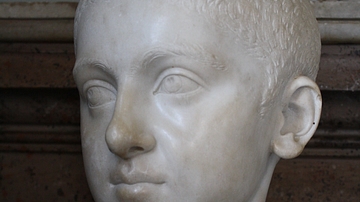
Severus Alexander Bust, Vatican Museums
A marble bust of Roman emperor Severus Alexander, r. 222-235 CE. (The Vatican Museums, Rome).
