
Search
Remove Ads
Advertisement
Search Results

Article
The Admonitions of Ipuwer - A Tale of Chaos and the Importance of Government
The Admonitions of Ipuwer (also known as The Papyrus Ipuwer and The Admonitions of an Egyptian Sage) is a literary text dated to the Middle Kingdom of Egypt (2040-1782 BCE). The...

Article
The Atrahasis Epic: The Great Flood & the Meaning of Suffering
The Atrahasis is the Akkadian/Babylonian epic of the Great Flood sent by the gods to destroy human life. Only the good man, Atrahasis (his name translates as `exceedingly wise') was warned...

Article
Most Popular Gods & Goddesses of Ancient China
There were over 200 gods and goddesses worshipped throughout ancient China, but if one were to count every deity or spirit, the number would be over 1,000. Each town, village, city, field, farm, and sometimes...

Article
Magic in Ancient Egypt
In ancient Egypt, if a woman were having difficulty conceiving a child, she might spend an evening in a Bes Chamber (also known as an incubation chamber) located within a temple. Bes was the god of childbirth, sexuality...

Article
The Instructions of Shuruppag - Ancient Philosophical Wisdom
The Instructions of Shuruppag (circa 2500/2000 BCE) is the most famous work of the genre of Sumerian wisdom literature whose purpose was to encourage proper behavior in conformity with cultural...
Article
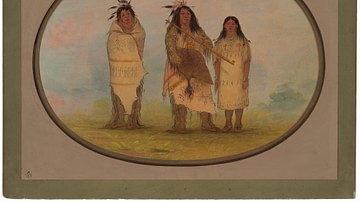
The Life and Death of Sweet Medicine
The Life and Death of Sweet Medicine is a Cheyenne tale of the great prophet and law-giver Sweet Medicine who received the sacred Four Arrows, structure of government, and rules of society from Maheo, the Wise...

Article
Religion & Superstition in Colonial America
Religion and superstition went hand in hand in Colonial America, and one’s belief in the first confirmed the validity of the second. The colonists' worldview was completely informed by religion and so everything...

Article
Dialogue of Pessimism
The Dialogue of Pessimism (c. 1000 BCE) is a Babylonian poem featuring a master and his slave in ten exchanges during which the master proposes an action, and the slave gives reasons for and against its pursuit. The piece...

Article
Coyote Tales of the Shasta Nation
The Coyote tales come from the Shasta people who originally inhabited the regions of modern-day northern California and southern Oregon. Coyote is a popular trickster figure among many Native peoples of North America...

Article
Norse Alcohol & The Mead of Poetry
Alcohol played an integral part in Norse culture. People drank ale more than water because the brew had to be boiled as part of the process and so was safer to drink. The Norse of Scandinavia had four main types...
