
Search
Remove Ads
Advertisement
Search Results

Image
Cavea, Theatre of Orange
The restored seating area (cavea) of the 1st century CE Roman theatre at Arausio (Orange, France). Originally, the theatre had capacity for 9,000 spectators.

Image
Orange Tree Egg by Fabergé
The 1911 Orange Tree Egg by Peter Carl Fabergé (1846-1920). The egg was given by Tsar Nicholas II (r. 1894-1917) to his mother the Dowager Empress Marie Feodorovna. The egg is made of nephrite, white quartz, gold, and enamel. It is set with...
Image
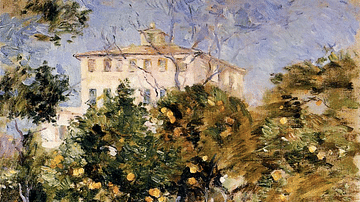
Villa with Orange Trees by Morisot
An 1882 oil on canvas painting, Villa with Orange Trees, by Berthe Morisot (1841-95), the French impressionist painter. This scene was painted around Nice in southern France. (Private Collection)
Image
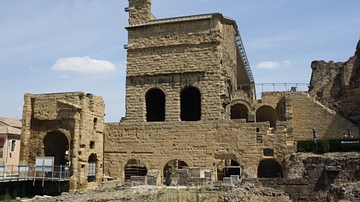
Side View, Theatre of Orange
The monumental arched entrances to the 1st century CE Roman theatre of Arausio (Orange, France).
Image
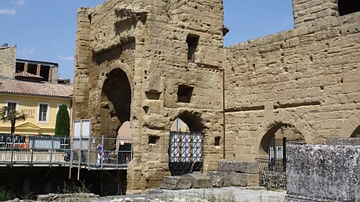
Entrance Arch, Theatre of Orange
The monumental arched entrance of the 1st century CE Roman theatre at Arausio (Orange, France).
Image
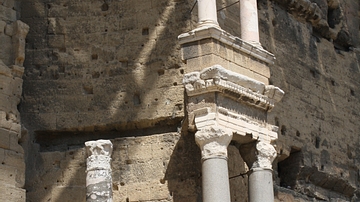
Columns, Orange Theatre Stage Wall Facade
A detail of the facade of the stage wall of the the 1st century CE Roman theatre at Arausio (Orange, France).
Image
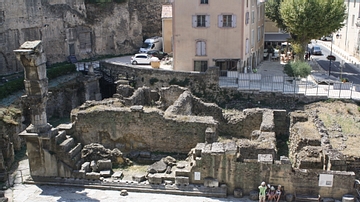
Roman Temple, Theatre of Orange
The ruins of the 2nd century CE Roman temple, probably dedicated to the emperor, which is located next to the 1st century CE theatre of Arausio (Orange, France).
Image
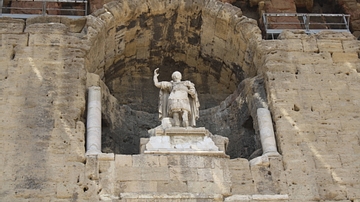
Colossal Statue of Augustus, Theatre of Orange
The colossal statue of Augustus (restored) set in the facade of the stage wall of the theatre of Arausio (Orange, France). 1st century CE. The statue is 3.5 metres tall.
Image
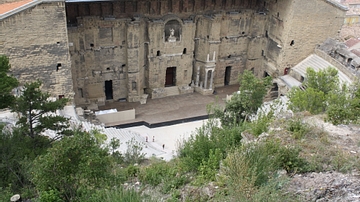
Stage Wall, Theatre of Orange
The stage wall of the 1st century CE Roman theatre at Arausio (Orange, France).

Article
The Impact of the Norman Conquest of England
The Norman conquest of England, led by William the Conqueror (r. 1066-1087 CE) was achieved over a five-year period from 1066 CE to 1071 CE. Hard-fought battles, castle building, land redistribution, and scorched earth tactics ensured that...
