
Search
Remove Ads
Advertisement
Search Results

Image
The Clock of Andronicus Cyrrhestes
Also known as the Tower of the Winds because of the relief carvings of the eight winds near its top, this marble tower, built in the first century BCE, contained the clock which ran on water from the Acropolis spring. It was located in the...
Image
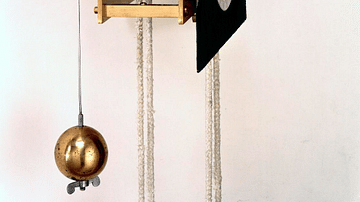
Huygen's Pendulum Clock
A reconstructed model of a pendulum clock designed and built by the Dutch mathematician and astronomer Christiaan Huygens (1629-1695). The device has two weights and two pulleys which are driven by the swing of the pendulum. (Science Museum...
Image
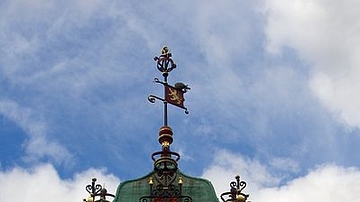
Eastgate Clock Chester
The Eastgate Clock, Chester, Cheshire, England. Stands on the site of the original entrance to the Roman fortress of Deva Victrix. Installed in 1899 CE.
Image
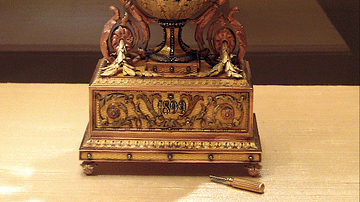
Madonna-Lily Clock Egg by Fabergé
The 1899 Madonna-Lily Clock Egg by Peter Carl Fabergé (1846-1920). The egg was given by Tsar Nicholas II (r. 1894-1917) to his wife Alexandra Feodorovna. The egg is made of gold with yellow enamel and set with rose diamonds. The central white...
Image
Arkwright's Water Frame
An example of a water frame (a machine for spinning cotton) as invented by Richard Arkwright in Nottinghamshire in 1769. It was powered by a water wheel and increased the speed that yarn could be spun. (Science Museum, London)
Image
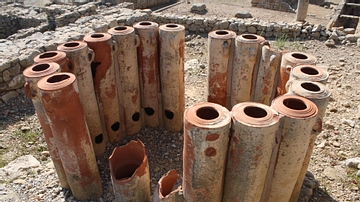
Ground Water Filter, Empuries
A terracotta ground water filter, in situ. 3rd century BCE, Greek Empuries (Emporion or Emporiae), Spain.

Definition
Qanat
The qanat (called foggara in North Africa and the Levant, falaj in the United Arab Emirates and Oman, kariz in Iran, and puquios in Peru) is an ancient Middle Eastern irrigation technique in which a long tunnel is dug into arid land that...

Definition
Scientific Revolution
The Scientific Revolution (1500-1700), which occurred first in Europe before spreading worldwide, witnessed a new approach to knowledge gathering – the scientific method – which utilised new technologies like the telescope to observe, measure...

Video
Neo-Assyrian Water Basin from Assur
This water basin was originally cut from a single basalt block. When it was discovered, it was completely shattered into several pieces. It was located in one of the courtyards of the temple of Assur. On the corners and in the center of each...
Image
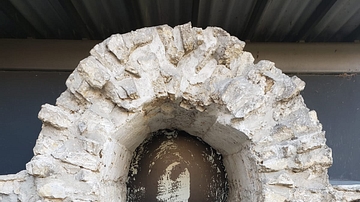
Roman Water Main from Augusta Raurica
The arch shown here was part of an underground water main, which from c. 70 CE, brought large quantities of water to Augusta Raurica, which is located in present-day Switzerland. It supplied the public baths, latrines, and water fountains...
