
Search
Remove Ads
Advertisement
Search Results
Definition
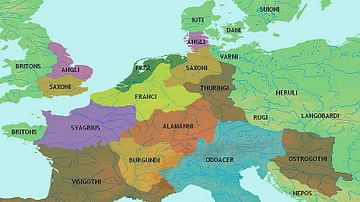
Alemanni
The Alemanni (also known as the Alamanni and the Alamans, meaning "All Men" or "Men United") were a confederacy of Germanic-speaking people who occupied the regions south of the Main and east of the Rhine rivers in present-day Germany. Many...

Definition
Avars
The Avars were a confederation of heterogeneous (diverse or varied) people consisting of Rouran, Hephthalites, and Turkic-Oghuric races who migrated to the region of the Pontic Grass Steppe (an area corresponding to modern-day Ukraine, Russia...

Definition
Hayasa-Azzi
The Hayasa-Azzi were an indigenous Bronze Age tribal confederation which flourished on the plateau of ancient Armenia and eastern Anatolia between c. 1500 and c. 1200 BCE. Although the historical record is impoverished and disputed regarding...

Definition
James Monroe
James Monroe (1758-1831) was an American statesman who served as the fifth president of the United States (1817-1825). The fourth president to belong to the so-called 'Virginia Dynasty', and the last of the generation of the Founding Fathers...

Definition
Henry Lee III
Henry Lee III (1756-1818), more commonly known by his nickname 'Light-Horse Harry' Lee, was a cavalry officer in the Continental Army during the American Revolutionary War (1775-1783) and a politician who served as the ninth Governor of Virginia...
Definition
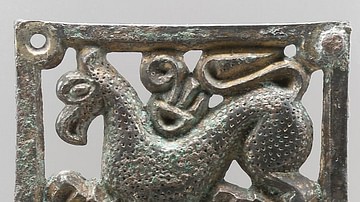
Bayan I
Bayan I (reigned 562/565-602 CE) was a king of the Avars, a confederation of heterogeneous people who migrated from the region of Mongolia, north of China, in 552 CE and came in contact with the Eastern Roman Empire c. 557 CE. Bayan I is...

Definition
Nefertiti
Nefertiti (c. 1370 - c. 1336 BCE) was the wife of the pharaoh Akhenaten of the 18th Dynasty of Egypt. Her name means, `the beautiful one has come' and, because of the world-famous bust created by the sculptor Thutmose (discovered in 1912...

Definition
Faras Cathedral
The Cathedral of Faras, a city in ancient Nubia and once the capital of the Kingdom of Faras (aka Nobatia), was built and rebuilt from the 8th to 11th century CE. Its interior was decorated with hundreds of frescoes which are amongst the...

Article
The Twelve Tribes of Israel
The Twelve Tribes of Israel refer to the sons of the Jewish Patriarch Jacob and are important for the tribal lineages of those who constituted the nation of Israel. In the ancient world, all ethnic groups developed stories of their ancestors...

Article
Battle of Jena-Auerstedt
The twin battles of Jena and Auerstedt, both fought on 14 October 1806, marked a major turning point in the Napoleonic Wars (1803-1815). It saw the French Grande Armée, led by Emperor Napoleon I (r. 1804-1814; 1815) soundly defeat the Prussian...
