
Search
Remove Ads
Advertisement
Search Results

Definition
Ancient Korean Architecture
The architecture of ancient Korea is epitomised by the artful combination of wood and stone to create elegant and spacious multi-roomed structures characterised by clay tile roofing, enclosures within protective walls, interior courtyards...

Definition
Queen Seondeok
Queen Seondeok (Sondok) ruled the ancient kingdom of Silla from 632 to 647 CE and was the first female sovereign in ancient Korea. Silla was on the verge of dominating the whole of the Korean peninsula and Seondeok helped progress her kingdom...

Definition
Silla
The Silla kingdom ruled south-eastern Korea during the Three Kingdoms period from the 1st century BCE to 7th century CE. The capital was Geumseong (Gyeongju) with a centralised government and hierarchical system of social ranks. The prosperity...

Definition
Chang'an
Chang'an, located near modern Xian in Shaanxi Province, was the capital of several dynasties of ancient China from the Zhou to the Tang and eventually became one of the world's great metropolises. With regular tree-lined avenues, high walls...

Definition
Ancient Pyongyang
Pyongyang (aka Pyeongyang) was the capital of several successive ancient Korean kingdoms. Located on the Daedong River in the north of the peninsula, the site was chosen by the legendary Dangun (Tangun), founder of the first Korean state...

Definition
Yama
Yama is the Hindu god of death, king of ancestors, and final judge on the destination of souls. He is also known as the 'Restrainer', Pretaraja or 'King of Ghosts', Dharmaraja or 'King of Justice', and as Daksinasapati is considered the regent...
Definition
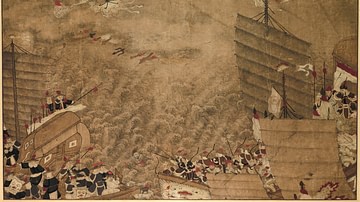
Wako - The Medieval Pirates of Southeast Asia
Wako (aka wokou and waegu) is a term used to refer to Japanese (but also including Chinese, Korean, and Portuguese) pirates who plagued the seas of East Asia from Korea to Indonesia, especially between the 13th and 17th centuries CE. Besides...

Definition
Jade Emperor
The Supreme August Jade Emperor is the supreme deity of Chinese tradition and is otherwise known as Yuhuang Shangdi (Yu-huang Shang-ti), Yudi (Yu Ti) or Mr. Heaven (Lao-t'ien ye). He governs the cosmos and resides in a magnificent palace...
Image
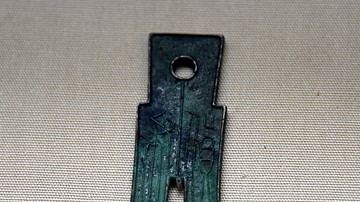
Chinese Bronze Hoe Coin
Bronze spade money (worth 25 standard coins) with Chinese inscription, minted in China under the rule of Wang Mang, Xin Dynasty, 9-23 CE. Wang Mang's four coinage reforms were not successful and the widely accepted wuzhu were soon reissued...
Image
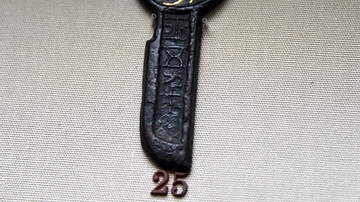
Bronze Knife Coin
So-called knife money, worth 5000 standard coins. Obverse, Chinese inscription. Minted in China; ruler Wang Mang. Wang Mang's four coinage reforms were not successful and the widely accepted wuzhu were soon re-issued. Xin Dynasty, 9-23 CE...
