
Search
Remove Ads
Advertisement
Search Results
Image
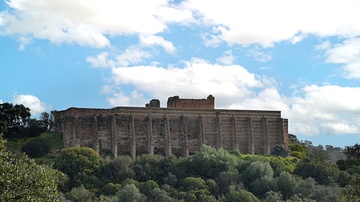
Terraced Sanctuary of Munigua, Spain
View of the western wall of the terraced sanctuary of Munigua (Spain) built in around 70 CE. Located on the slope of a hill, the santuary was reinforced by buttresses at the rear, giving it the appearance of a fortress.

Image
Miravet Castle, Spain
The castle of Miravet, north-east Spain, built by the medieval military order the Knights Templar (c. 1119-1312 CE), which they acquired in 1153 CE.
Image
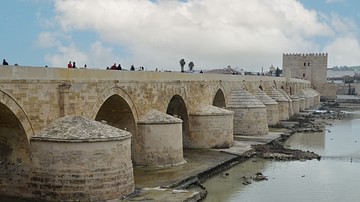
Roman Bridge of Córdoba, Spain
The Roman bridge of Córdoba is located in the Historic centre of Córdoba (declared a World Heritage Site in 1984), Andalusia, southern Spain. It was originally built in the early 1st century BCE across the Guadalquivir river, though it has...
Image
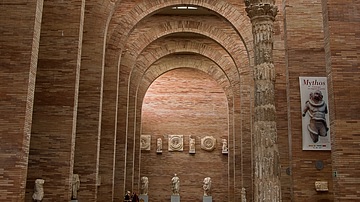
National Museum of Roman Art in Mérida, Spain
Main hall of the National Museum of Roman Art in Mérida (Spanish: Museo Nacional de Arte Romano), Spain. Inaugurated in 1986, the magnificent building, reflecting certain aspects of Roman architecture, occupies some 5000 m² ((53819 ft²...
Image
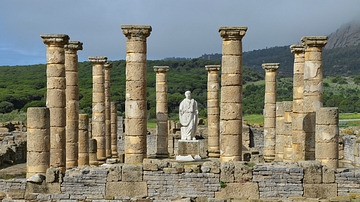
Basilica of Baelo Claudia, Spain
The Basilica at Baelo Claudia in Southern Spain, built around 50-60 CE to the South of the Forum of the city. It was a two-storey building built of ashlar and concrete walls covered in stucco. The city erected a colossal statue of Trajan.
Image
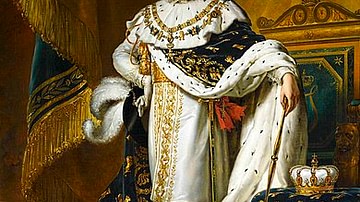
Joseph Bonaparte As King of Spain
Portrait of Joseph Bonaparte (1768-1844) as king of Spain (r. 1808-1813) in his coronation robes, oil on canvas by François Gérard, 19th century.
Musée national du Château de Fontainebleau.
Image
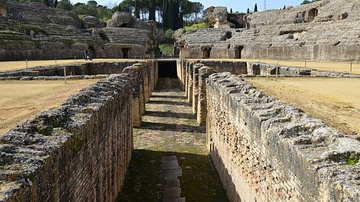
Roman Amphitheatre of Italica (Spain)
The Roman amphitheatre of Italica (located in modern-day Santiponce, 9 kilometres north of Seville in Spain) was one of the largest in the Empire, measuring 160 by 137 metres (525 by 450 feet). It was built during the reign of emperor Hadrian...

Image
Philip of Anjou is Proclaimed King of Spain
Philip of France, Duke of Anjou, Proclaimed King Philip V of Spain, 16 November 1700, oil on canvas by François Gérard, 1824.
Philip's accession to the Spanish throne triggered the War of the Spanish Succession.
Château de Chambord.
Image
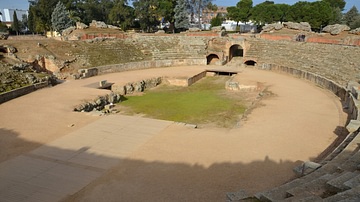
Roman Amphitheatre of Augusta Emerita (Mérida, Spain)
The amphitheatre of Augusta Emerita (modern-day Mérida, Spain) was construced in 8 BCE for use in gladiatorial contests and staged beast-hunts. It had a capacity of up to 15,000 people. The elliptical building was of considerable dimentions...
Image
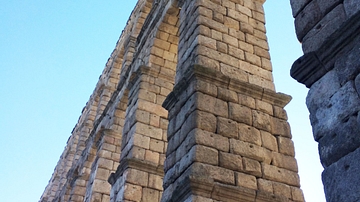
View of the Roman Aqueduct in Segovia, Spain
The Segovia Aqueduct was likely finished around the year 112 CE and once carried water from the Rio Frio situated 17 km (11 miles) from Segovia. It is one of Spain's cultural treasures, and it was listed in the 2006 World Monuments Watch...
