
Search
Remove Ads
Advertisement
Search Results

Image
Temple of Venus, Baalbek
Temple of the goddess Venus in the Baalbek temple complex, Lebanon, early 3rd century CE.

Image
The Birth of Venus by Botticelli
By Sandro Botticelli (1445–1510 CE), commissioned by Lorenzo and Giovanni di Pierfrancesco de'Medici for Villa di Castello (?).
Image
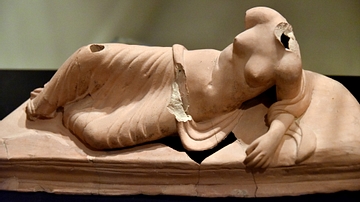
Reclining Aphrodite-Venus from Jerash
Terracotta figurine of the goddess on a large couch (cline), leaning on her left elbow. This was the typical position for dining at a banquet (symposium), which was derived from the Greek tradition and was adopted...

Video
Temple of Venus & Rome - Ancient Rome Live
The colossal Temple of Venus and Rome was one of Rome's largest imperial temples. It essentially enveloped the Velia Hill, next to the Palatine and overlooking the Colosseum valley. Hadrian constructed this...
Video
Nude Woman (Venus of Willendorf), c. 28,000-25,000 B.C.E.
More free lessons at: http://www.khanacademy.org/video?v=ENAZqOoOVaI
Nude Woman (Venus of Willendorf), c. 28,000-25,000 B.C.E., Limestone, 4 1/4" high (Naturhistorisches Museum, Vienna)
Image
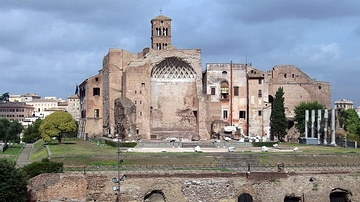
Temple of Venus and Roma, Rome
The Temple of Venus and Rome (Templum Veneris et Romae) is thought to have been the largest temple in Ancient Rome. The architect was the emperor Hadrian and construction began in 121 CE. It was officially inaugurated...
Image
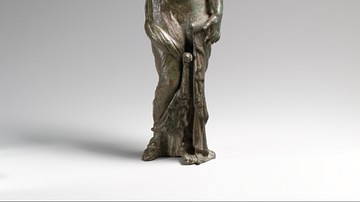
Statuette of Isis-Venus
This bronze statuette from the late 2nd Century CE depicts the Egyptian goddess Isis in Hellenized form as Aphrodite but wearing the traditional vulture cap and knotted robe of Isis. Isis was a popular deity in the Roman...
Image
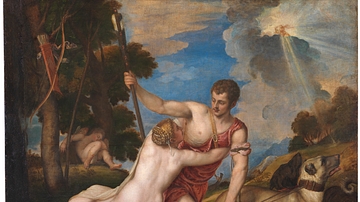
Venus and Adonis by Titian
The Venus and Adonis painting by the Italian Renaissance artist Titian (c. 1487-1576 CE). c. 1554 CE. (Prado Museum, Madrid)

Image
Bronze Figure of Venus
This is a bronze figure of Venus, goddess of love, fertility, sex, and beauty. Roman period, c. 1st century CE. Bequeathed by R. Payne Knight. (The British Museum, London).

Image
Venus of Brassempouy
The Venus of Brassempouy is one of the earliest known realistic representations of a human face. It belongs to the Gravettian culture of Upper Palaeolithic Europe and was probably carved between c. 26,000 and c. 24,000 years...
