
Search
Did you mean: Arabia?
Remove Ads
Advertisement

 This answer was generated by
 Search Results
Image
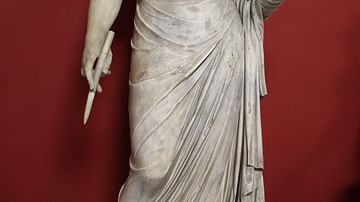
Urania
A sculpture of Urania, the Muse of Astronomy. Originally the statue was of Persephone but recarved and with a head addded taken from a 2nd century CE statue of another Muse. (Vatican Museums, Rome).
Image
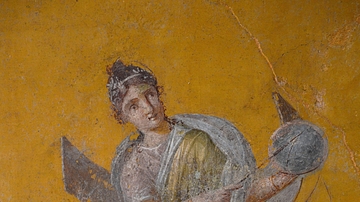
Fresco with Urania
A fresco fragment depicting Urania, the Muse of Astronomy, from the House of Julia Felix in Pompeii, 62-79 CE. (now in Louvre Museum, Paris)
Definition
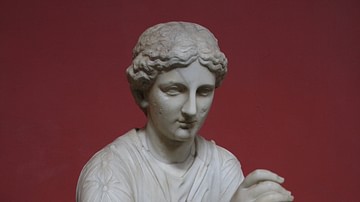
Calliope
Calliope (also spelt Kalliope) is the Muse of epic poetry and heroic song in Greek mythology. She is considered the leader of the Muses and the most honoured of them all. She is often represented in art with a tablet on her knee and a stylus...

Article
Women Scientists in the Scientific Revolution
Women scientists during the Scientific Revolution (1500-1700) were few in number because male-dominated educational institutions, as well as scientific societies and academies, barred women entry, meaning that few had the education or opportunity...

Definition
Tycho Brahe
Tycho Brahe (1546-1601) was a Danish nobleman who made the most significant contribution to our knowledge of astronomy before the telescope arrived. He discovered a supernova, observed the elliptical interplanetary orbit of a comet, updated...

Image
The Nine Muses of Greek Mythology
The Nine Muses of Greek mythology were divine daughters of Zeus and Mnemosyne (Memory), revered as patrons of poetry, song, history, and the arts. Early Greek tradition sometimes spoke of an earlier triad—Mneme (Memory), Melete (Practice...

Article
A Visual Who's Who of Greek Mythology
Achilles The hero of the Trojan War, leader of the Myrmidons, slayer of Hector and Greece's greatest warrior, who sadly came unstuck when Paris sent a flying arrow guided by Apollo, which caught him in his only weak spot, his heel. Adonis...

Article
Observatories in the Scientific Revolution
The foundation of observatories during the Scientific Revolution (1500-1700) followed a process of evolution from entirely independent observatories operated by a single astronomer to private observatories which received state or private...

Article
Hesiod on the Birth of the Gods
The Greek poet Hesiod (c. 700 BCE) is most famous for his works Theogony and Works and Days. In this passage from Theogony, Hesiod relates the birth of the gods from cosmic Chaos and follows the lineage through the great Zeus, King of the...

Definition
Ancient Greek Dance
In ancient Greece, dance had a significant presence in everyday life. The Greeks not only danced on many different occasions, but they also recognized several non-performative activities such as ball-playing or rhythmic physical exercise...
