
Search
Did you mean: Leo III?
Remove Ads
Advertisement
Search Results

Image
King Tiglath-pileser III
An alabaster bas-relief depicting the Assyrian king Tiglath-pileser III. From the central palace, Nimrud (ancient Kalhu), Mesopotamia, northern Iraq. Neo-Assyrian era, circa 728 BCE. (The British Museum, London)

Image
Tiglath-pileser III, Submission of Enemy
An alabaster bas-relief depicting the Assyrian king Tiglath-pileser III stands over a captured enemy. The cuneiform inscription describes an Assyrian campaign in Iran 744 BCE. From the central palace at Nimrud...

Image
Captured Flocks from Arab Enemies of Tiglath-pileser III
Sheep and goats, captured in a campaign against the Arabs are driven back to the Assyrian camp. This scene decorated the palace of King Tiglath-pileser III (reigned 744-727 BCE. Assyrian, about...

Image
Tiglath Pileser III
Detail of a gypsum wall relief showing the Assyrian king Tiglath Pileser III from the South-West palace at Nimrud, Mesopotamia, modern-day Iraq, Neo-Assyrian Empire, 745-727 BCE. The king is recognizable by his long beard...

Image
A Wall Relief from Tiglath-Pileser III's Palace
A man holds a mace and a bow and a number of cows appear behind him. The name of the man is unknown. A fragment of a limestone wall relief from the palace of Tiglath-pileser III at Nimrud (ancient Kalhu...
Image
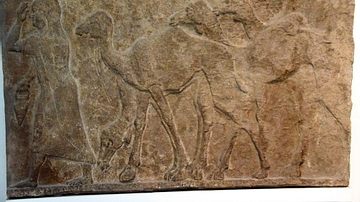
Captured Camels from Arab Enemies of Tiglath-pileser III
The woman on the left and the herd of camels behind her are part of a procession of prisoners and booty captured during one of the military campaigns of Tiglath-pileser III (reigned 744-727 BCE...

Image
Yazdegerd III
Coin of Yazdegerd III (r. 632-651 CE).

Definition
Assyrian Warfare
Assyria began as a small trading community centered at the ancient city of Ashur and grew to become the greatest empire in the ancient world prior to the conquests of Alexander the Great and, after him, the Roman Empire. While...

Image
Tomb Relief of Amenhotep III
This limestone relief of the Egyptian pharaoh Amenhotep III (c. 1386-1353 BCE) came from the Tomb (TT57) of Khaemhat at Western Thebes (in modern-day Sheikh Abd el-Qurna), Egypt. Amenhotep III was depicted in profile...
Image
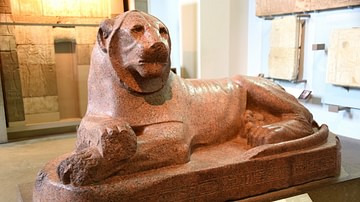
King Amenhotep III as a Lion
Statue of Amenhotep III, declares the king's might by representing him as a lion, from Napata (Gebel Barkal, Sudan), originally from Soleb (Sudan), 18th Dynasty, reign of Amenhotep III, 1390-1352 BCE. Pharaohs were...
