
Search
Remove Ads
Advertisement
Search Results

Definition
Henry VI of England
Henry VI of England ruled as king from 1422 to 1461 and again from 1470 to 1471. Succeeding his father Henry V of England (r. 1413-1422), Henry VI was crowned the king of France in 1431 but he could not prevent a French revival...

Definition
Gustav Holst
Gustav Holst (1874-1934) was a British composer of Swedish origin most famous for his dramatic orchestral suite The Planets, first performed in public in 1919. Holst also composed several operas, wrote sacred choral works such as...

Article
The Integration of Church and State in the Roman Empire
In the ancient world, "religion" and society were not separate entities. Various gods dictated covenants, "law-codes," and social conventions. Such law-codes were most often the responsibility of...

Definition
Christianity
Christianity is the world's largest religion, with 2.8 billion adherents. It is categorized as one of the three Abrahamic or monotheistic religions of the Western tradition along with Judaism and Islam. 'Christian' is derived from...

Definition
George Berkeley
George Berkeley (1685-1753) was an Anglo-Irish bishop and an empiricist and idealist philosopher. He infamously claimed that no matter exists outside of God and that things only exist outside of our minds and perceptions because...

Article
William Harvey's Discovery of Blood Circulation
The human body's system of blood circulation was discovered by the English physician and anatomist William Harvey (1578-1657) in 1628. Harvey determined the relationship between the blood system of arteries...

Definition
Holy Roman Empire
The Holy Roman Empire officially lasted from 962 to 1806. It was one of Europe’s largest medieval and early modern states, but its power base was unstable and continually shifting. The Holy Roman Empire was not a unitary state...
Definition
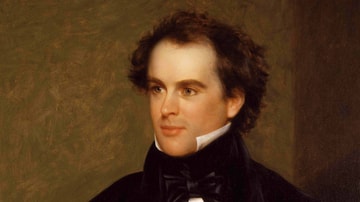
Nathaniel Hawthorne
Nathaniel Hawthorne (1804-1864) was an American author of novels and short stories, who produced some of the most memorable works of American literature: the novels The Scarlet Letter and The House of the Seven Gables as well...

Definition
Christopher Marlowe - Poet, Playwright, Spy
Christopher Marlowe (1564-1593), or Kit Marlowe, was a poet and playwright of the English Renaissance who wrote during the Elizabethan Era (1558-1603). His mastery of the blank verse – unrhymed iambic pentameter...

Definition
Franklin Pierce - The Tragic US President
Franklin Pierce (1804-1869) was an American lawyer and politician who served as the fourteenth president of the United States. An unremarkable politician prior to his election, his presidency was marred by...
