
Search
Remove Ads
Advertisement
Search Results

Definition
Protestant Reformation
The Protestant Reformation (1517-1648) refers to the widespread religious, cultural, and social upheaval of 16th-century Europe that broke the hold of the medieval Church, allowing for the development of personal interpretations of the Christian...

Article
Life of Plato of Athens
Plato of Athens (424 or 423 to 347 BCE) was an ancient Greek philosopher whose work is considered so important that he may be called the inventor of philosophy as we understand the term today. Some people would want to reserve that honor...
Definition
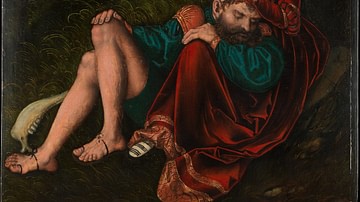
Samson
Samson was one of the last judges in the Hebrew Book of Judges who arose as a leader of the Jews when they settled in Canaan. He was a Nazirite, known for his incredible strength, the secret of which was discovered by Delilah who betrayed...
Definition
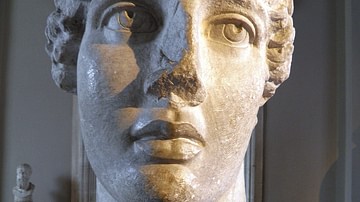
Lesbos
Lesbos, a Greek island located in the eastern Aegean, had several prosperous city-states which thrived from the Bronze Age to the Byzantine era. Switching many times between independence, Persian and Greek control, Lesbos was often a victim...

Definition
Gela
Gela (Greek: Ghéla), in southern Sicily, was a Greek colony founded c. 689 BCE and it remained an important cultural centre throughout antiquity. Prospering on trade and expanding its territory, the city-state founded Agrigento. In the 5th...

Definition
Polycrates
Polycrates (r. c. 535-522 BCE) was the tyrant of Samos who established Samian naval supremacy in the eastern Aegean and strove for control of the Aegean Sea and mainland towns of Ionia in the 6th century BCE. Polycrates had a successful career...

Definition
Socrates
Socrates of Athens (l. c. 470/469-399 BCE) is among the most famous figures in world history for his contributions to the development of ancient Greek philosophy which provided the foundation for all of Western Philosophy. He is, in fact...

Definition
The Pentecontaetia
The Pentecontaetia (Pentekontætia, πεντηκονταετία) or “the account of the fifty years” is a term first used by Thucydides to describe, in Book 1, Sections 89 to 117 (1.89-117) of his History of the Peloponnesian War, the period between the...

Article
Robespierre & the Death Penalty
"I come to ask, not the gods, but legislators…to erase from the code of the French the blood laws that command judicial murders" (Robespierre, 6). These impassioned words, spoken by Maximilien Robespierre before France's National Constituent...
Article
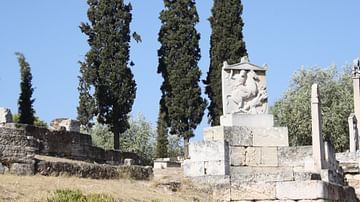
The Dexileos Stele: A Study of Aristocracy and Democracy in Greek Art
The Dexileos Stele assesses the way that Athenian political thought penetrated all levels of society, showing the conflict that the aristocratic classes were faced with in trying to find their place within the Athenian Democracy. As a visual...
