
Search
Remove Ads
Advertisement
Search Results
Definition
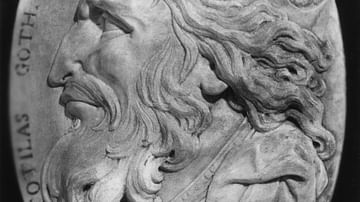
Totila
Totila (birth name, Baduila-Badua r. 541-552 CE) was the last great king of the Ostrogoths in Italy. He was the nephew of the Gothic king Ildibad who was succeeded by Eraric the Rugian (d. 541 CE). The Goths of Italy felt that Eraric...
Image
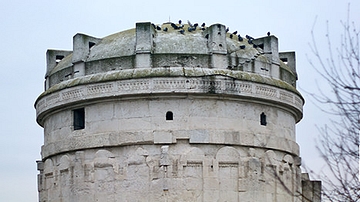
Mausoleum of Theodoric
The Mausoleum of Theodoric, king of the Ostrogoths, 6th century CE. (Ravenna, Italy)

Article
Boethius: First of the Medievals?
Anicius Manlius Severinus Boethius (c. 477-524/525) was a scholar in Late Antiquity who was imprisoned and executed by Theodoric (r. 493-526 CE) but was later idolised by medieval intellectuals. His most famous work...

Definition
Western Roman Empire
The Western Roman Empire is the modern-day term for the western half of the Roman Empire after it was divided in two by the emperor Diocletian (r. 284-305 CE) in c. 285/286 CE. The Romans themselves did not use this term...

Definition
The Goths
The Goths were a Germanic tribe who are frequently referenced for their part in the fall of the Roman Empire and their subsequent rise to power in the region of northern Europe, initially in Italy. Prior to their contact with Rome...

Article
The Battle of the Catalaunian Fields
The Battle of the Catalaunian Fields (also known as The Battle of Chalons, The Battle of Maurica) was one of the most decisive military engagements in history between the forces of the Roman Empire under Flavius...

Definition
Visigoth
The Visigoths were the western tribe of the Goths (a Germanic people) who settled west of the Black Sea sometime in the 3rd century CE. According to the scholar Herwig Wolfram, the Roman writer Cassiodorus (c. 485-585 CE) coined the...

Definition
Attila the Hun
Attila the Hun (r. 434-453 CE) was the leader of the ancient nomadic people known as the Huns and ruler of the Hunnic Empire, which he established. His name means "Little Father" and, according to some historians, may not have...

Definition
Belisarius
Flavius Belisarius (l. 505-565 CE) was born in Illyria (the western part of the Balkan Peninsula) to poor parents and rose to become one of the greatest generals, if not the greatest, of the Byzantine Empire. Belisarius is listed...

Definition
Anastasios I
Anastasios I ruled the Byzantine empire from 491 to 518 CE. Although his tax and monetary reforms were both popular and successful, the emperor could not repair the damaging split in the Christian Church created by his predecessors...
