
Search
Did you mean: Petrarch?

 This answer was generated by
 Search Results

Image
The Roman Tetrarchy Under Diocletian, 293–305 CE - An Empire Rebuilt — Stability Through Division, Succession by Design
This map illustrates the Roman Tetrarchy, a four-part imperial system established by Emperor Diocletian (reigned 284–305 CE) in 293 CE to stabilize and defend the sprawling Roman Empire. It aimed to address political instability, streamline...

Image
Map of the Herodian Tetrarchy in the Levant, c. 5 CE
This map illustrates the geopolitical situation in the Levant after the death of Herod the Great (ruled 37–4 BCE), the ambitious client king of Judea appointed by the Roman Senate. His death marked the breakup of his kingdom into the Herodian...

Definition
Diocletian
Diocletian was Roman emperor from 284 to 305 CE. After the defeat and death of the Roman emperor Philip the Arab in 249 CE, the empire endured over three decades of ineffective rulers. The glory days of Augustus, Vespasian, and Trajan were...

Definition
Roman Empire
The Roman Empire, at its height (c. 117), was the most extensive political and social structure in western civilization. Building upon the foundation laid by the Roman Republic, the empire became the largest and most powerful political and...

Definition
Galatia
Galatia was a region in north-central Anatolia (modern-day Turkey) settled by the Celtic Gauls c. 278-277 BCE. The name comes from the Greek for "Gaul" which was repeated by Latin writers as Galli. The Celts were offered the region by the...

Article
Legions of Late Antiquity
The Roman army underwent dramatic changes in Late Antiquity. Civil war and external conflicts led to the creation of new legions while existing legions were either split or disbanded. Although there was an increase in the number of legions...
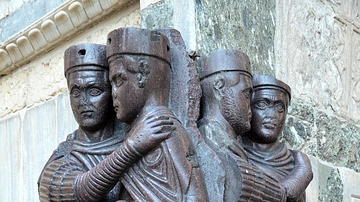
Image
Portrait of the Four Tetrarchs
Porphyry sculpture portraying the four Tetrarchs (Diocletian, Maximianus, Galerius and Constantius Chlorus) embracing. It is dated to c. 300 CE and was sculpted in Asia Minor. It probably originally decorated two separate pillars in Constantinople...

Definition
The Crisis of the Third Century - A Pivotal Era of Ancient Rome
The Crisis of the Third Century (also known as the Imperial Crisis, 235-284) was the period in the history of the Roman Empire during which it splintered into three separate political entities: the Gallic Empire, the Roman Empire, and the...

Definition
Constantinople
Built in the seventh century BCE, the ancient city of Byzantium proved to be a valuable city for both the Greeks and Romans. Because it lay on the European side of the Strait of Bosporus, the Emperor Constantine understood its strategic importance...

Definition
The Barracks Emperors - Instability of Populist Rule
The "barracks emperors" is a term coined by later historians referring to the Roman emperors who were chosen and supported by the army during the period known as the Crisis of the Third Century (also known as the Imperial Crisis, 235-284...
