
Search
Remove Ads
Advertisement

 This answer was generated by
 Search Results

Definition
Electrical Telegraph
The electrical telegraph was invented in 1837 by William Fothergill Cook (1806-1879) and Charles Wheatstone (1802-1875) in England with parallel innovations being made by Samuel Morse (1791-1872) in the United States. The telegraph, once...
Image
Telegraph Morse Key
A morse key for an electrical telegraph machine. From a British post office and in use in the 19th to 20th century. (Science Museum, London)

Image
The First Telegraph Machine
The first telegraph machine, invented in 1837 by William Fothergill Cook (1806-79) and Charles Wheatstone (1802-1875). The machine had only 20 letters, indicated in the message sent by the slight movement of two needles (from the machine’s...

Image
Samuel Morse, the Telegraph, 1837
A gouache on paper painting titled Samuel Morse, the Telegraph, 1837 by Nicha Sursock. This is part of a series of 43 works representing the history of the USA. On May 24, 1844 Morse sent the first official long-distance telegraph from...

Image
Hughes' Typewriting Telegraph
The typewriting telegraph invented by David E Hughes (c. 1829-1900) in 1855. The machine could transform telegraph messages into written text. (Science Museum, London)

Image
Samuel Morse's First Telegraph Machine
A model of the first telegraph machine developed by Samuel Morse (1791-1872) of Massachusetts, probably made around 1835. (Science Museum, London)
Image
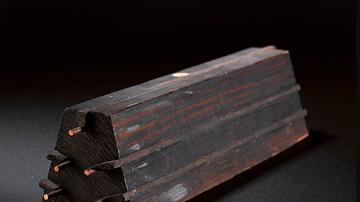
The First Telegraph Cable
A section of the first electrical telegraph cable, used for a machine invented by William Fothergill Cook and Charles Wheatstone in London in 1837. Made of copper and wood, the cable was first used underground before it was decided to suspend...

Image
SS Great Eastern Laying a Telegraph Cable
A colour print of an illustration by Robert Charles Dudley showing the SS Great Eastern laying the first Atlantic telegraph cable in 1865-7. The steamship was designed by Isambard Kingdom Brunel (1806-59) and completed in 1858. It was the...

Article
Top 10 Inventions of the Industrial Revolution
The British Industrial Revolution transformed life at work and at home for practically everyone. Noise, pollution, social upheaval, and repetitive jobs were the price to pay for labour-saving machines, cheap and comfortable transportation...
Image
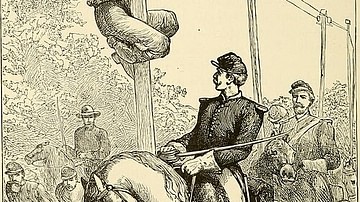
J. E. B. Stuart's Cavalry Cutting Union Telegraph Wires
Confederate General J. E. B. Stuart (1833-1864) had his cavalry cut the telegraph lines used by the Union army during one of his raids at the end of 1862. Illustration from Makers of the world's history and their grand achievements by Henry...
