
Search
Remove Ads
Advertisement
Search Results

Article
Cultural Links between India & the Greco-Roman World
Cyrus the Great (558-530 BCE) built the first universal empire, stretching from Greece to the Indus River. This was the famous Achaemenid Empire of Persia. An inscription at Naqsh-i-Rustam, the tomb...
Article
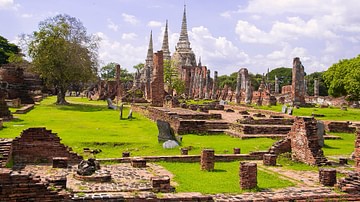
Ayutthaya: Venice of the East
The royal city of Ayutthaya (ah-you-tah-ya) was a small kingdom in Siam (modern Thailand), and it was an unrivalled commercial and maritime power from 1350-1767 CE. Ayutthaya became the second capital of Siam in 1438...

Definition
Hanuman
Hanuman is one of several zoomorphic characters in Indian mythology, but is the only wholly animal figure who is revered as a god today. The mythic texts speak of him as a monkey child of the Wind God, as possessing enormous strength...

Definition
Angkor Wat
Angkor Wat is a temple complex in the province of Siem Reap, Cambodia originally dedicated to the Hindu god Vishnu in the 12th century CE. It is among the largest religious buildings ever created, second only to the Temple of Karnak...
Definition
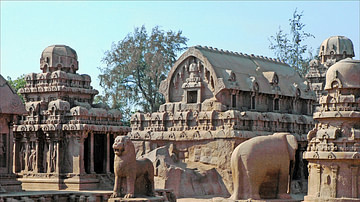
Mahabalipuram
Mahabalipuram or Mamallapuram is a historic city and UNESCO World Heritage site in Tamil Nadu, India. During the reign of the Pallava dynasty, between the 3rd century CE and 7th century CE, it became an important centre of art...

Definition
Romani Language
Romani is an Indo-European language, belonging to the Indic subbranch which includes Sanskrit and Hindi. Because of the Romani diaspora throughout Europe and West Asia, it developed in close contact with European and Iranian languages...

Definition
Ancient Indian Warfare
War was the chief means by which territory was annexed or rulers defeated in ancient India, which was divided into multiple kingdoms, republics and empires. Often one empire predominated or different empires co-existed...

Image
Twelve Steels That Forged History - Metallurgical Revolutions That Changed Civilization.
Steel, an alloy based principally on iron and carbon, has been one of humanity’s most transformative materials. From early bloomery production in the ancient Near East to...

Image
Twelve Spices That Changed the World - Trade, Empire, and the Global Age of Spices, 1450–1650
Between c. 1450 and 1650, demand for spices and other high-value plant commodities became an important catalyst for European maritime expansion. Pepper, cinnamon, cloves...

Video
Ancient City of Polonnaruwa (UNESCO/NHK)
Polonnaruwa was the second capital of Sri Lanka after the destruction of Anuradhapura in 993 A.D.. It comprises, besides the Brahmanic monuments built by the Cholas, the monumental ruins of the fabulous garden-city...
