
Search
Remove Ads
Advertisement
Search Results

Image
Map of the Spanish Colonial Empire
This map illustrates the rise and expansion of the Spanish Colonial Empire during the Age of Exploration, from the late 15th to the early 19th century. Emerging after the completion of the Reconquista in 1492 and the voyages of Christopher...

Article
The Colonial Bungalow - Combatting Climate & Creating Separation
With its thick walls, high ceilings, large rooms, and wide verandahs, the colonial bungalow was constructed to meet the challenges of hot climates. Designed to keep cool air in, hot air out, and provide plenty of airy shade, the bungalow...

Definition
Spanish Requirement
The Spanish Requirement or Requerimiento was a document intended to be read out to and agreed upon by indigenous peoples during the Spanish conquest of the Americas. Created in 1513, the document outlined the history of Christianity, the...

Definition
Buccaneer
The buccaneers were privateers who attacked enemies of their state, namely Spain, in the Caribbean and on the American coast (the Spanish Main) throughout the 17th century. Initially hunters and then seamen and soldiers, the buccaneers successfully...

Article
Colonial American Currency
Colonial American currency was a work in progress from the time of the earliest English settlements of the 1600s until the United States of America minted its own money in 1783. The monetary system was far from standardized, and trade within...

Definition
Francis Drake
Sir Francis Drake (c. 1540-1596 CE) was an English mariner, privateer and explorer who in 1588 CE helped defeat the Spanish Armada of Philip II of Spain (r. 1556-1598 CE) which attempted to invade the kingdom of Elizabeth I of England (r...
Article
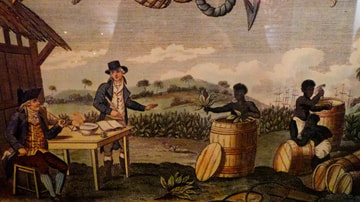
Tobacco & Colonial American Economy
The most important cash crop in Colonial America was tobacco, first cultivated by the English at their Jamestown Colony of Virginia in 1610 CE by the merchant John Rolfe (l. 1585-1622 CE). Tobacco grew in the wild prior to this time and was...
Article
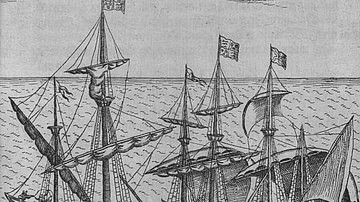
The Sea Dogs - Queen Elizabeth's Privateers
The sea dogs, as they were disparagingly called by the Spanish authorities, were privateers who, with the consent and sometimes financial support of Elizabeth I of England (r. 1558-1603 CE), attacked and plundered Spanish colonial settlements...

Article
Slavery in Colonial America
Slavery in Colonial America, defined as white English settlers enslaving Africans, began in 1640 in the Jamestown Colony of Virginia but had already been embraced as policy prior to that date with the enslavement and deportation of Native...

Article
The Changing Interpretation of the Spanish Conquest in the Americas
The fall in 1519 of Tenochtitlan, the capital of the Mexica or Aztec Empire, as it was later called, laid the foundation for the Spanish colonial empire on the North American mainland. It was the first time that Europeans had subjugated a...
