
Search
Did you mean: Solon?
Remove Ads
Advertisement

 This answer was generated by
 Search Results
Image
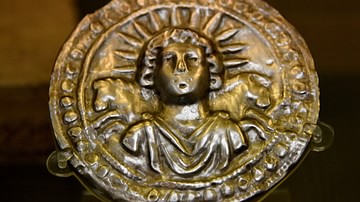
Disc Dedicated to the Sun-God Sol
Silver leaf disc dedicated to the sun god Sol. Sol is crowned with rays. Two horses appear behind his shoulders. From Pessinus (Bala-Hissar, Asia Minor), in modern-day Turkey. Roman period, 3rd century CE. The British...
Image
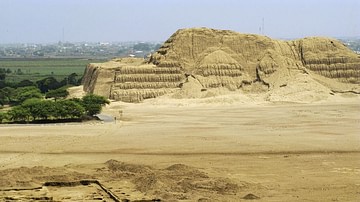
Huaca del Sol, Moche
The remains of the Huaca del Sol pyramid at Moche, Peru. The huge ceremonial mound had four tiers and was constructed using over 140 million adobe bricks. Reaching a height of 50 metres, the site was used for religious and...

Article
Constantine’s Conversion to Christianity
Constantine I (Flavius Valerius Constantinus) was Roman emperor from 306-337 CE and is known to history as Constantine the Great for his conversion to Christianity in 312 CE and his subsequent Christianization...

Definition
Helios
Helios (also Helius) was the god of the Sun in Greek mythology. Helios rode a golden chariot which brought the Sun across the skies each day from the east (Ethiopia) to the west (Hesperides). Helios was famously the subject of the Colossus...

Definition
Moche Civilization
The Moche civilization (also known as the Mochica) flourished along the northern coast and valleys of ancient Peru, in particular, in the Chicama and Trujillo Valleys, between 1 CE and 800 CE. The Moche state spread to eventually...
Definition
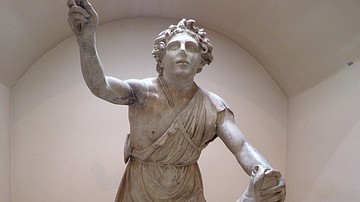
Mithraism
The Mithraic Mysteries, also known as Mithraism, were a mystery cult in the Roman world where followers worshipped the Indo-Iranian deity Mithras (Akkadian for "contract") as the god of friendship, contract and order. The cult first...

Definition
Aurelian
Aurelian was Roman emperor from 270 to 275 CE. He was one of the so-called Barracks Emperors, chosen by the Roman army during the turbulent period known as the Crisis of the Third Century (235-284 CE). Besides victories against various...

Article
The Sun & the Moon in Norse Myth
In Norse mythology, the Sun and the Moon appear as personified siblings pulling the heavenly bodies and chased by wolves, or as plain objects. Written sources, such as the Poetic Edda and the Prose Edda, have surprisingly...

Definition
Constantine I
Constantine I, aka Constantine the Great, was Roman emperor from 306 to 337 CE. Realizing that the Roman Empire was too large for one man to adequately rule, Emperor Diocletian (284-305 CE) split the empire into two, creating a...
Definition
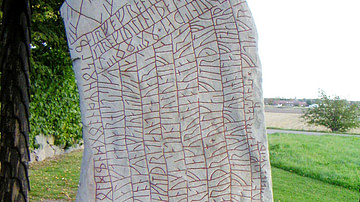
Runes
Runes are letters in the runic alphabets of Germanic-speaking peoples, written and read most prominently from at least c. 160 CE onwards in Scandinavia in the Elder Futhark script (until c. 700 CE) and the Younger Futhark - which illuminated...
