
Search
Remove Ads
Advertisement
Search Results

Definition
American Revolution
The American Revolution (1765-1789) was a period of political upheaval in the Thirteen Colonies of British North America. Initially a protest over parliamentary taxes, it blossomed into a rebellion and led, ultimately, to the...

Definition
Louis I de Bourbon, Prince of Condé
Louis I de Bourbon (l. 1530-1569) was a descendant of Louis IX of France (r. 1226-1270) and founder of the House of Condé. The Prince of Condé proved his valor as a Huguenot military leader during the first three...

Definition
Herakleia Lynkestis
Herakleia Lynkestis (Heraclea Lyncestis; Ἡράκλεια Λυγκηστίς) was a city in the ancient kingdom of Macedon not far from modern Bitola, founded c. 358 BCE by Philip II of Macedon (r. 359-336 BCE) as a governing centre for his...
Image
Richard III is Tormented by the Ghosts of His Victims - Richard III, Act V, Scene III
Richard III of England is tormented by the ghosts of his victims on the eve of his death at the Battle of Bosworth, in Act V Scene III of William Shakespeare's play The Tragedy...
Image
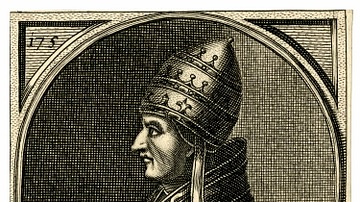
Pope Innocent III
Pope Innocent III (not to be confused with anti-pope Innocent III), r. 1198-1216 CE, is depicted in this print from Chronologia Summorum Romanorum Pontificum, published in 1675 CE. The text at the bottom reads "Innocent III...

Article
Medieval Knights: 12 of the Best
The knights of medieval Europe were meant to be the finest fighting men of their age, even more important, they were expected to be pure in thought and deed, as exemplified in the chivalrous code which they (usually...

Article
Byzantine Icons
Icons, that is images of holy persons, were an important part of the Byzantine Christian Church from the 3rd century CE onwards. Venerated in churches, public places, and private homes, they were often believed to have protective...
Article
Twelve Great Women of Ancient Persia
Women in ancient Persia had more rights and greater freedom than any other ancient civilization including, according to some scholars, even ancient Egypt which is famous for its respect for the feminine principle...

Article
The Siege of Damascus, 1148 CE
The siege of Damascus in 1148 CE was the final act of the Second Crusade (1147-1149 CE). Lasting a mere four days from 24 to 28 July, the siege by a combined western European army was not successful, and the Crusade...

Article
Legions of Judea
Judea was initially dependent on its neighbor Syria for military support until it received a Roman legion of its own in 70 CE after the Great Jewish Revolt of 66 CE. Legio X Fretensis was stationed at remains of the burned city...
