
Search
Remove Ads
Advertisement
Search Results
Image
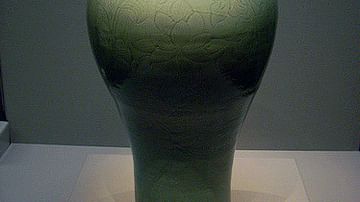
Maebyeong Celadon Vase, Goryeo Dynasty
A maebyeong celadon vase with lotus decoration. 12th century CE, Goryeo Dynasty, Korea. (National Museum of Korea, Seoul, South Korea)

Video
Oracle Bones of the Ancient Chinese Shang Dynasty
Oracle bones or dragon bones were the shoulder blades of oxen or the flat underside of a turtle shell known as a plastron that were used for divination during the Shang Dynasty of China which dates between c. 1600 and 1046 BCE. The bones...
Image
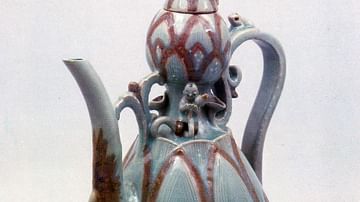
Celadon Ewer, Goryeo Dynasty
A celadon gourd-shaped ewer deocrated with lotus petals. 13th century CE, Goryeo Dynasty, Korea. (Leeum, Samsung Museum of Art, Seoul, South Korea)

Image
Bronze Korean Coin, Goryeo Dynasty
A bronze coin of the Korean Goryeo Dynasty, 1097-1105.
The legend reads: Haedong tongbo meaning 'Coin of the Land East of the Sea' (Korea).
The British Musem, London.
Image
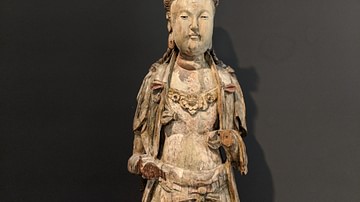
Guanyin, Song Dynasty
Guanyin, the Bodhisattva of Compassion. Song Dynasty (960-1279 CE), China. Wooden, painted and gilded. Exhibited at Museum Rietberg, Zurich, Switzerland.

Image
Goryeo Dynasty Bronze Coin
A bronze coin of the Korean Goryeo Dynasty. The legend reads: Tongguk tongbo,
meaning 'Coin of the Eastern Kingdom' (Korea). 1097-1105 CE. (British Musem, London)

Image
Palace Scene in Zhou Dynasty China
Artist's impression of a palace scene in Zhou Dynasty China. Created by Amplitude Studios for the video game Humankind.
Image
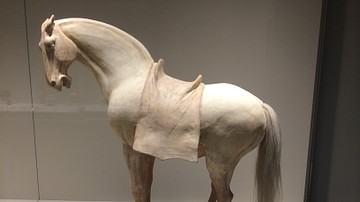
Tang Dynasty Horse
A unglazed ceramic horse from the Tang Dynasty. China, 8th century CE. (St. Louis Art Museum, Missouri)
Image
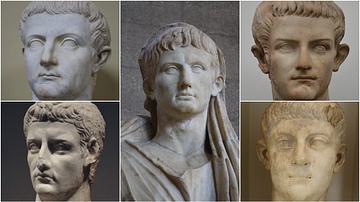
The Julio-Claudian Dynasty
The five Roman emperors of the Julio-Claudian dynasty. These were: - Augustus (r. 27 BCE - 14 CE) - centre photo - Tiberius (r. 14-37 CE) - top left - Caligula (r. 37-41 CE) - top right - Claudius (r. 41-54 CE) - bottom left - Nero...
Image
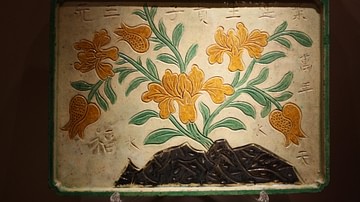
Jin Dynasty Stoneware Tray
A glazed stone tray, 12th century CE, Jin Dynasty. (Museum of Asian Art, Corfu)
