
Search
Remove Ads
Advertisement
Search Results

Article
Warrior Women of the World of Ancient Macedon
The 8th November is celebrated as Archangels Day in Greece, but on that November day in 1977 CE something remarkable happened: an excavation team led by Professor Manolis Andronikos were roped down into...

Article
How the World Was Made: A Cherokee Creation Story
How the World Was Made is a creation story of the Cherokee nation, which, like many such tales of the Native peoples of North America, begins with a world covered by water from which dry land is formed...

Article
Ancient Persian Gods, Heroes, and Creatures - The Complete List
The term 'mythology' comes from the Greek mythos (story-of-the-people) and logos (word or speech), meaning the spoken story of a people. Every civilization of the ancient world developed a...

Article
Libraries in the Ancient World
Libraries were a feature of larger cities across the ancient world with famous examples being those at Alexandria, Athens, Constantinople, Ephesus, and Nineveh. Rarely ever lending libraries, they were typically designed...
Image
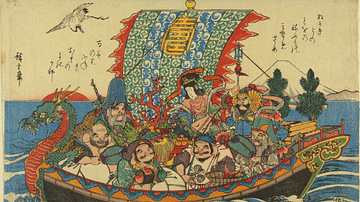
Seven Lucky Gods on Takarabune
The Seven Lucky Gods (aka Shichifukujin) of Japanese folklore on their treasure ship or takarabune. By Hiroshige (1797-1858 CE). Woodblock print, c. 1840 CE. (Victoria & Albert Museum, London)
Image
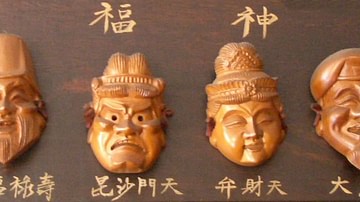
Seven Lucky Gods
The Seven Lucky Gods or Shichifukujin of Japanese folklore. From left to right: Soldan Sağa Hotei, Juroujin, Fukurokuju, Bishamonten, Benzaiten, Daikokuten, Ebisu

Video
Ancient wonders captured in 3D (Ben Kacyra)
http://www.ted.com Ancient monuments give us clues to astonishing past civilizations — but they're under threat from pollution, war, neglect. Ben Kacyra, who invented a groundbreaking 3D scanning system...

Article
Genocide in the Ancient World
Genocide is often viewed as a particular feature of our own current age. This perception largely stems from the terrible events which took place during World War Two in the 20th century CE in the parts of Europe occupied...

Video
The Wonders of Ancient Mesopotamia
Following on from the immensely successful "Day in Pompeii" exhibit, Melbourne Museum again contracted Zero One to create animation that captures the look and feel of the ancient city of Ur. Many weeks of research...

Video
Ancient Wonders: Pyramids
Egypt's ancient pyramids have left visitors awestruck for thousands of years, and continue to do so today.
