
Search
Remove Ads
Advertisement
Search Results

Image
Philosophy Presenting the Seven Liberal Arts to Boethius
Anicius Manlius Severinus Boethius (c. 475-525 CE) is depicted on the far left. An allegory of Philosophy presents to him the allegories of the Seven Liberal Arts dressed in 15th century clothing...

Image
Galahad Battles the Seven Knights of Darkness
"The seven knights of darkness" was painted c. 1893-1902 CE. The painting depicts the legendary Sir Galahad battling personifications of the Seven Deadly Sins as part of his quest for the Holy Grail. It...

Article
The Home Fronts in World War I - The Effects of Total War on Civilians
The First World War (1914-18) saw fighting on an unprecedented scale but also involved civilians as never before. For the first time, people hundreds of miles from the fighting front...

Image
The Seven Sacks of Rome
An infographic of the seven times the city of Rome was sacked. Across more than 1,900 years (390 BCE–1527 CE), the sacks of Rome reveal not a single moment of collapse, but a recurring pattern of vulnerability shaped by...

Image
Portrait of Seven Notable Greek Physicians & Botanists
An illustration of seven noted physicians and botanists from ancient Greece in the Vienna Dioscurides(aka the Juliana Anicia Codex), a 6th Century CE Byzantine manuscript of De Materia Medica by...

Article
Key British Weapons of World War I
The First World War (1914-18) witnessed an arsenal of new weapons as all sides were desperate to gain an advantage, particularly in the static trench warfare of the Western Front. There were some old tried-and-tested...
Image
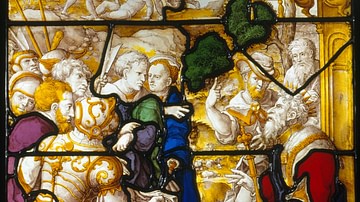
Martyrdom of the Seven Maccabee Brothers and Their Mother
Martyrdom of the Seven Maccabee Brothers and Their Mother, stained glass by Dirck Vellert, Antwerp, c. 1530-35.
Metropolitan Museum of Art, New York.

Image
The Seven Voyages of Zheng He
A map showing the route and destinations of the seven voyages of Zheng He between 1405 and 1433 CE, acting as an ambassador and explorer of the Chinese Ming Dynasty (1368 to 1644 CE).

Image
Knight Battling the Seven Sins
A 13th century CE illustration of a knight about to battle the Seven Deadly Sins. From the Summa Vitiorum or "Treatise on the Vices" by William Peraldus.

Image
The Seven Liberal Arts
Education personified. Philosophy sits in the center surrounded by the Seven Liberal Arts: Rhetoric, Dialectic, Grammar, Mathematics, Geometry, Music, and Astronomy. Illustration from "Hortus deliciarum" by Herrad von Landsberg...
