
Search
Remove Ads
Advertisement
Search Results

Article
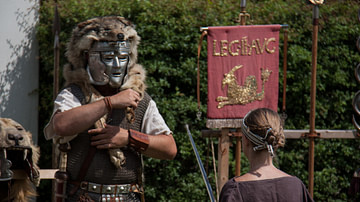
The Year of the Four Emperors & the Demise of Four Roman Legions
During the Year of the Four Emperors (69 CE), the fight between Vitellius and Vespasian would ultimately bring about the demise of four legions, the XV Primigenia, I Germanica, IIII Macedonica...
Article
Legions of Britain
After the Roman emperor Claudius (r. 41-54 CE) successfully conquered Britain in 43 CE, four legions were left there to maintain the peace: XIV Gemina, II Augusta, IX Hispana, and XX Valeria Victrix. However, by the end of the...

Article
Female Gladiators In Ancient Rome
Female gladiators in ancient Rome – referred to by modern-day scholars as gladiatrix – may have been uncommon but they did exist. Evidence suggests that a number of women participated in the public games of Rome...

Article
Mark Antony's Parthian Campaign
In 36 BCE, Mark Antony (83-30 BCE) invaded Parthia, hoping to render himself one of the great conquerors of the Greco-Roman world, but he was stymied by Parthian forces and obliged to undertake an arduous, costly retreat...
Article
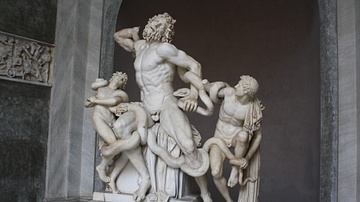
Laocoön: The Suffering of a Trojan Priest & Its Afterlife
The sculpture group of Laocoön and His Sons, on display in the Vatican since its rediscovery in 1506, depicts the suffering of the Trojan prince and priest Laocoön (brother of Anchises) and his...

Article
Julius Caesar: The Faults Behind the Myth
Last March marked the anniversary of Julius Caesar's assassination over 2,000 years ago, and after two millennia, his legendary achievements still linger in today's consciousness just as they have for centuries...

Article
Roman Students in Athens
Training in oratory was a crucial part of Roman education; it was associated with a young boy's transition into adult life. As Athens was considered the intellectual centre of the eastern Mediterranean, many students undertook...
Article
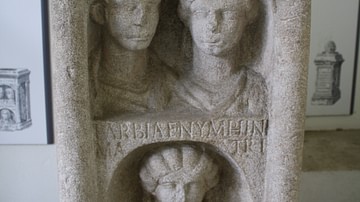
Ancient Roman Family Life
Whether there was a king, a consul, or an emperor that stood supreme over Rome and its territories, the one constant throughout Roman history was the family. Like many earlier societies, the family was the fundamental...

Article
A Roman Boy's Rite of Passage
A Roman boy's rite of passage, a ceremony or ritual marking a transitional period in life from childhood to adulthood, was the assuming of the toga virilis, the adult toga. The ceremony usually took place sometime between...

Article
Roman Girls and Marriage in Ancient Rome
In ancient Rome, the legally acceptable age for marriage for girls was twelve. Although in middle-class Roman society, the most common age of first marriage for a girl was mid-to-late teens, evidence also shows...
