
Search
Did you mean: Derbent?
Remove Ads
Advertisement
Search Results

Definition
Serpent Mound
Serpent Mound (also known as Great Serpent Mound) is an archaeological and historic site in Peebles, Ohio, USA, enclosing an effigy mound 1348 feet (411 m) long in the shape of a serpent, the largest effigy mound of a serpent in...

Article
Setna I: A Detailed Summary & Commentary
Setna I (also Setna Khaemaus and the Mummies) is a work of ancient Egyptian literature from the Ptolemaic Period (323-30 BCE) written in demotic script. It is part of a cycle of stories known as the Tales of...
Article
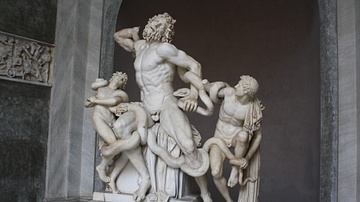
Laocoön: The Suffering of a Trojan Priest & Its Afterlife
The sculpture group of Laocoön and His Sons, on display in the Vatican since its rediscovery in 1506, depicts the suffering of the Trojan prince and priest Laocoön (brother of Anchises) and his...

Article
A Brief History of Veterinary Medicine
The English word 'veterinarian' as defining one who provides medical care to animals, comes from the Latin verb veheri meaning “to draw” (as in "pull") and was first applied to those who cared for “any animal...

Article
Medicine in Ancient Mesopotamia - A Gift of the Gods to Their People
In ancient Mesopotamia, the gods informed every aspect of daily life, including the practice of medicine. Gula, the Sumerian goddess of healing, presided over the medical arts, guiding...

Article
Elephants in Hellenistic History & Art
Elephants were thought of as fierce and frightful monsters in antiquity, very real though rarely seen until the Hellenistic period. They were deployed on the battlefield to strike terror into the enemy, however...

Article
The Daughter of the Sun
The Daughter of the Sun is a Cherokee origin myth explaining how Uktena, the great horned serpent, came to be, as well as why those who die cannot return to life. The story also explains the respect due to the rattlesnake...

Article
The Mesopotamian Pantheon - The Ancient Gods and Goddesses of the Near East
The gods of the Mesopotamian region were not uniform in name, power, provenance or status in the hierarchy. Mesopotamian culture varied from region to region and, because of this...

Article
The Myth of Etana - Faith and Kingship in Ancient Mesopotamia
The Myth of Etana is the story of the Sumerian antediluvian King of Kish who ascends to heaven on an eagle to request the Plant of Birth from the gods so that he might have a son. Etana is named...

Article
Enuma Elish - The Babylonian Epic of Creation - Full Text
The Enuma Elish (also known as The Seven Tablets of Creation) is the Babylonian creation myth whose title is derived from the opening lines of the piece, "When on High". The myth tells the story...
