
Search
Did you mean: Selinus?
Remove Ads
Advertisement
Search Results

Definition
Ottoman Empire
The Ottoman Sultanate (1299-1922 as an empire; 1922-1924 as caliphate only), also referred to as the Ottoman Empire, written in Turkish as Osmanlı Devleti, was a Turkic imperial state that was conceived by and named after Osman...
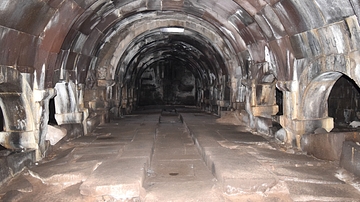
Image
Interior of Selim Caravanserai
This medieval caravanserai located in present-day Armenia is located on the ancient Dvin Partav international trade route, which included the Selim Mountain Pass. (It was part of the ancient Silk Road.) Built from...

Definition
Abbasid Dynasty
The Abbasids were an Arabic dynasty that initially ruled over most of the Islamic empire (save some western parts) after assuming the caliphate in 750 CE, later on, their empire fragmented, however, they retained spiritual supremacy...

Definition
Scythian Warfare
Scythian warfare used state-of-the-art recurve bows and hit-and-run tactics against set infantry formations. Working from nimble horses, Scythian warriors could unleash a cloud of lethal arrows. Known, too, for their innovative...

Image
Splitting at the Timber Yard - Viking Ship Construction 16
In the Viking timber yard, large logs were split from the root end. Small wedges first opened a line, then larger wedges and mallet blows drove the split deeper, and the wood followed its natural...

Image
Axe-Based Production - Viking Ship Construction 18
At this stage, the saw had almost disappeared from the process of Viking shipbuilding, and production relied mainly on cleaving and axe hewing. Ship planks were made by opening the log along the grain...

Image
Wool Caulking - Viking Ship Construction 24
Before the overlap surfaces were closed on a Viking ship, a tarred three-ply wool cord was placed between them. Once compressed, this fibrous filler both closed the gap and made the entry of water more difficult...

Image
Broad-Bladed Axes - Viking Ship Construction 1
The broad-bladed axe was the Viking shipbuilder’s most important tool, and had been designed to turn oak logs into thin boards. Using these axes instead of a saw preserved the grain structure of the wood...

Image
Protective Tar Coating - Viking Ship Construction 25
In Viking shipbuilding, tar served not only to cover the fibre between the planks but also gave the outer hull additional protection. A mixture of wood, tar and linseed oil coated the outer surface...

Image
Searching for Curved Timber - Viking Ship Construction 10
In clinker Viking ships, branches and trunk junctions with natural curves were vital for making frames without cutting the fibres. This search for curved timber required extensive scanning within...
